


Prof Dr. Swaran Singh
(Author is former professor of School of International Studies, Jawaharlal Nehru University, New Delhi)
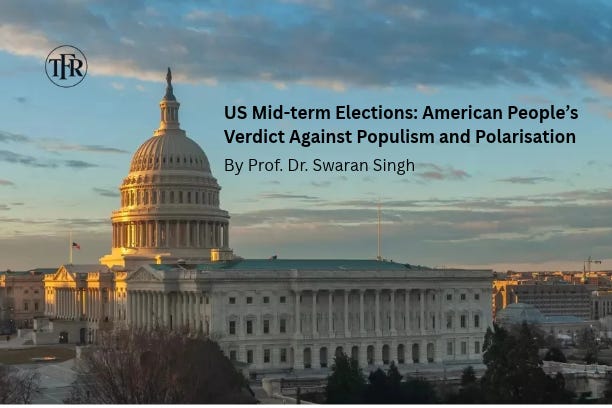
The 2026 midterm elections demonstrate that American democracy retains an extraordinary capacity for electoral correction — even when its political leadership appears increasingly invested in search of shortcuts to power and influence. In fact, there is something deeply reassuring about the American people’s historical relationship with democracy. The United States has repeatedly demonstrated that its democratic institutions, despite their imperfections, can outlive the political ambitions of those who temporarily occupy positions of power.
Perhaps the most remarkable illustration is the presidential election of 1800. Thomas Jefferson had defeated incumbent President John Adams in an extraordinarily bitter contest, marked by personal vilification, partisan hostility and fears of political instability. Yet the transfer of power from the Federalists to Jefferson’s Democratic-Republicans was peaceful. Jefferson famously described it as the restoration of political harmony, declaring in his inaugural address that Americans were all Republicans and all Federalists. The episode established an enduring democratic principle: political opponents could disagree profoundly without becoming enemies of the republic.
More than two centuries later, the November 3, 2026, midterm elections have offered another compelling illustration of this democratic resilience. By handing Democrats control of both chambers of the US Congress and inflicting substantial Republican losses across congressional and gubernatorial contests, American voters have delivered a powerful rebuke to President Donald Trump’s increasingly personalised, polarising and transactional style of politics. The verdict is not necessarily an ideological conversion to liberalism. It is, more importantly, a warning that electoral majorities cannot indefinitely be manufactured through populist promises, cultural antagonism and the politics of fear.
The politics of transactional populism
Perhaps the most revealing illustration was President Trump’s extraordinary promise of a $5,000 Trump Dividend to every adult American citizen if Republicans retained control of both the House of Representatives and the Senate. Announced at the Republican midterm convention in September, the proposal sought to transform an election into an apparently direct financial transaction between the President and voters. Its political proposition was remarkably simple: vote Republican and receive $5,000. But inspite of increasing hardships from rising cost of living this proposition could not lure average American voter.
Moreover, the economic credibility of this proposition was also deeply questionable. The payment could cost more than $1 trillion, and it would require congressional legislation. Also potentially, this was to add substantially to an already enormous federal debt and there have been repeated examples of standoffs when Congress has refused to raise the ceiling for executive seeking to raise more borrowings resulting in repeated government shut downs. Even earlier, Trump administrations had previously floated comparable giveaways financed through projected higher tariff revenues and savings from the Department of Government Efficiency, neither of which had materialised into the promised payments.
Fiscal experts warned that financing such a scheme through additional borrowing could aggravate inflationary and fiscal pressures. So, by all means, this was populism in its most transactional manifestation: presenting public money as a personal presidential dividend, while making its distribution conditional upon the electoral survival of his political party. It also personalised the democratic process by suggesting that the President, rather than the institutional machinery of government, was the source of national prosperity.
There was, however, an important distinction between the announcement and its wider reception. Just like on several other policies and propositions of President Trump, even within President Trump’s own party, these elections saw several Republican candidates avoiding embracing the proposal, recognising its fiscal vulnerabilities. The electorate’s subsequent verdict clearly revealed voters verdict that no such spectacular financial promise can necessarily compensate for anxieties about everyday economic conditions.
Turning identity into a political weapon
Even more disturbing was Trump administration’s reliance on religious and ethnic polarisation. The treatment of two prominent Muslim-American Democratic politicians, Representative Ilhan Omar of Minnesota and Michigan now-elected Senate candidate Abdul El-Sayed, became particularly revealing examples. This was again rejected by average American voter and has boomeranged on President’s personalised politics and his party’s future prospects.
For several years, President Trump and his close aids have targeted Ms Ilhan Omar, a Somali-American Muslim congresswoman, with inflammatory commentary. The political confrontation escalated dramatically when federal agents raided her Washington home in October, an action her office described as an abuse of federal power and political intimidation. Rather than allowing her legislative record and electoral accountability to determine her political standing, the campaign environment increasingly placed her immigrant background, religion and national loyalty under scrutiny. Nevertheless, Ms Ilhan Omar has since secured another term in Minnesota’s Fifth Congressional District.
The treatment of Abdul El-Sayed was even more explicit. Contesting Michigan’s Senate election where he now stands elected, El-Sayed faced repeated attempts to associate his Muslim identity with terrorism and the Muslim Brotherhood. Trump called him a jihadist, questioned his national loyalty and invoked the September 11 attacks to suggest that his election would represent a national-security threat. Trump even suggested that if elected Abdul El-Sayed’s entry to Senate chamber must be subjected to metal detectors. These humiliating commentaries were particularly consequential because there was no evidence that Abdul El-Sayed had any affiliation with the Muslim Brotherhood.
The politics of polarisation has apparently backfired. Abdul El-Sayed has since defeated Republican Mike Rogers by approximately seven percentage points, becoming the first Muslim to be elected to the United States Senate. His response was that the Michigan electorate rejecting such a hateful and spiteful campaign was more than an expression of personal satisfaction but this captures the larger political significance of this result. The Americans, who experienced 9/11, had an opportunity to endorse religious profiling but chose otherwise.
A geographically wider rejection
The significance of these results becomes clearer when examined beyond individual personalities. More that swing states, the Democrats have made substantial advances in congressional districts that Republicans had previously considered relatively secure. Kansas broke a 94-year record broken with Democrat Adam Hamilton defeating the Republican incumbent Roger Marshall, becoming the first Democrat elected to the US Senate from Kansas since 1932. This ended a 94-year Republican hold on the state’s Senate representation. Indeed, the overall Senate results were consequential. Democrats flipped Republican-held seats in Iowa, Ohio, North Carolina, South Carolina, Maine, Texas as well. These results demonstrated that even longstanding partisan loyalties could be unsettled when voters became dissatisfied with the national political direction.
Results show Democrats having flipped over 40 House seats. In Indiana’s Fifth Congressional District, Democrat J.D. Ford defeated Republican incumbent Victoria Spartz, who had won comfortably in 2024. In Missouri’s Second District, Fred Wellman unseated Republican Ann Wagner, despite the district having been regarded as solidly Republican. Wisconsin’s First District also changed hands, with Mitchell Berman defeating Republican incumbent Bryan Steil. These were not examples of simple victories in traditionally Democratic constituencies; they demonstrated the erosion of Republican electoral security in areas that had for long appeared resistant to a Democratic challenge. These newly elected Representatives and Senators will take office from 3rd January 2027.
In the governorships as well, this wider pattern stands re-enacted. Gina Hinojosa’s victory in Texas was especially noticeable, making her the state’s first Democratic governor in more than three decades. Keisha Lance Bottoms won in Georgia, while Amy Acton secured Ohio. These victories demonstrated that the Democratic advance was not confined to metropolitan liberal constituencies or the traditional Democratic strongholds of the Northeast and West Coast. It had acquired a geographically broader character. There is also an important sociological dimension. The elections produced several historic breakthroughs, including El-Sayed’s Senate victory and a wider representation of women and minority candidates.
Collectively, these election results have indicated a clear message: the assumption that American electoral politics can be mobilised most effectively by accentuating racial, religious and cultural differences stands rejected. Instead, the diversity of the victorious Democratic coalition suggests that political inclusion can be an electoral asset rather than a liability. At the same time, these elections are also being seem more in terms of rejection of Republican politics rather than a clear endorsement of left-leaning Democratic politics.
Populism is not exclusively Republican
An academically credible interpretation, however, must resist the temptation to portray the Democratic Party as entirely removed from populist politics. American populism has historically crossed ideological boundaries. Democrats also deployed anti-establishment rhetoric, criticised economic concentration and presented the elections as a struggle between average Americans and an increasingly unresponsive filthy-rich political elite.
Senator-elect Abdul El-Sayed’s campaign, for instance, combined an inclusive social message with a sharp critique of established political power. His victory speech captured this approach when he declared that America was big enough for everyone. Democratic candidates also mobilised economic anxieties over inflation, fuel prices and the cost of living, while portraying Republican policies as disproportionately beneficial to powerful interests. There was even that tone of caricaturing President Trump’s presidency.
So there was an element of polarisation in this strategy too. Democrats frequently framed the elections as a referendum on President Trump himself. White House’s crackdown on immigrants, ICE raids, embrace of artificial intelligence and data-center construction were often presented in personalised and rhetorical binaries. According to NBC exit polling cited by The New Yorker, forty-three per cent of voters identified opposition to President Trump as one reason for their vote. The Iran war, rising prices and concerns about Trump government’s accountability also contributed to rising dissatisfaction.
The distinction, therefore, is not that one party practised populism and polarisation while the other remained above it. Rather, voters appeared increasingly resistant to a particular genre of populism that substitutes personal loyalty for institutional accountability and the one that turns political disagreement into an existential conflict between supposedly incompatible identities. This makes it important not to simplify results into black and white and see voters rejection of a certain genre of politics sans personality-centric politics.
A referendum on democratic accountability
Therefore, the most consequential outcome of the recent US mid-term elections remains institutional rather than partisan. By transferring control of both congressional chambers, voters have restored the possibility of meaningful legislative oversight of the Trump administration. The new Democratic majorities can obstruct legislation, scrutinise executive decisions, investigate alleged abuses of authority and exercise their constitutional powers over various judicial, ambassadorial, executive appointments and financial appropriations. This is particularly significant in a political environment where the expansion of presidential authority has become a central constitutional controversy.
Second, these results have also exposed the limitations of presidential personalisation of elections. President Trump attempted to nationalise congressional contests, making Republican candidates increasingly dependent upon his political appeal. His mention of becoming “Mr Veto” and that Republicans would have won a landslide victory if ballot papers carried his face or name proved counterproductive of anything. This turned these midterm elections into referendum on Trump presidency. In response, American voters have demonstrated the dangers of such personalised strategy: when a President becomes the principal electoral asset of his party, his political liabilities become the liabilities of every candidate carrying its banner.
There is a warning for Democrats as well. Their victory should not be interpreted as an unconditional endorsement of their entire political programme. Voters may have rejected Trump’s whimsical and tumultuous style without necessarily embracing every Democratic policy prescription. The party will now be judged by its capacity to translate electoral success into legislative performance, economic relief and credible governance. This will determine the likely outcome of 2028 presidential race and whether coming two years will see any change in President Trump’s style of politics. This may also see President and Democratic majority Congress entangled in endless sabre-rattling.
The 2026 midterms consequently represent something more consequential than an ordinary midterm correction. They demonstrate the enduring tension between populist mobilisation and institutional underpinnings of American democracy, between the politics of identity and the politics of citizenship, and between personal political authority and constitutional accountability. American democracy has never been immune to demagoguery, racial prejudice, economic manipulation or political polarisation. Its history, from Jefferson’s peaceful transfer of power in 1800 to the civil rights movement of 1960s and subsequent struggles for democratic inclusion, is equally a history of citizens repeatedly challenging the boundaries imposed upon their democracy.
These recent mid-term elections offer one more such moment. Its message is not that populism has disappeared or that political polarisation has ended. Nor does it establish that Americans have suddenly become less ideologically divided. Rather, it demonstrates that electoral accountability remains possible even in an intensely polarised society. Perhaps the most important lesson is that American voters have reminded their political leadership of a fundamental democratic truth: the presidency belongs temporarily to an individual and that political power is held conditionally while the republic belongs to the people that constitute the solid foundations of American polity.
Prof. Dr. Swaran Singh is a member of The Frontier Review’s Editorial Advisory Board.
To learn more about the author, please visit our Editorial Advisory Board page.