


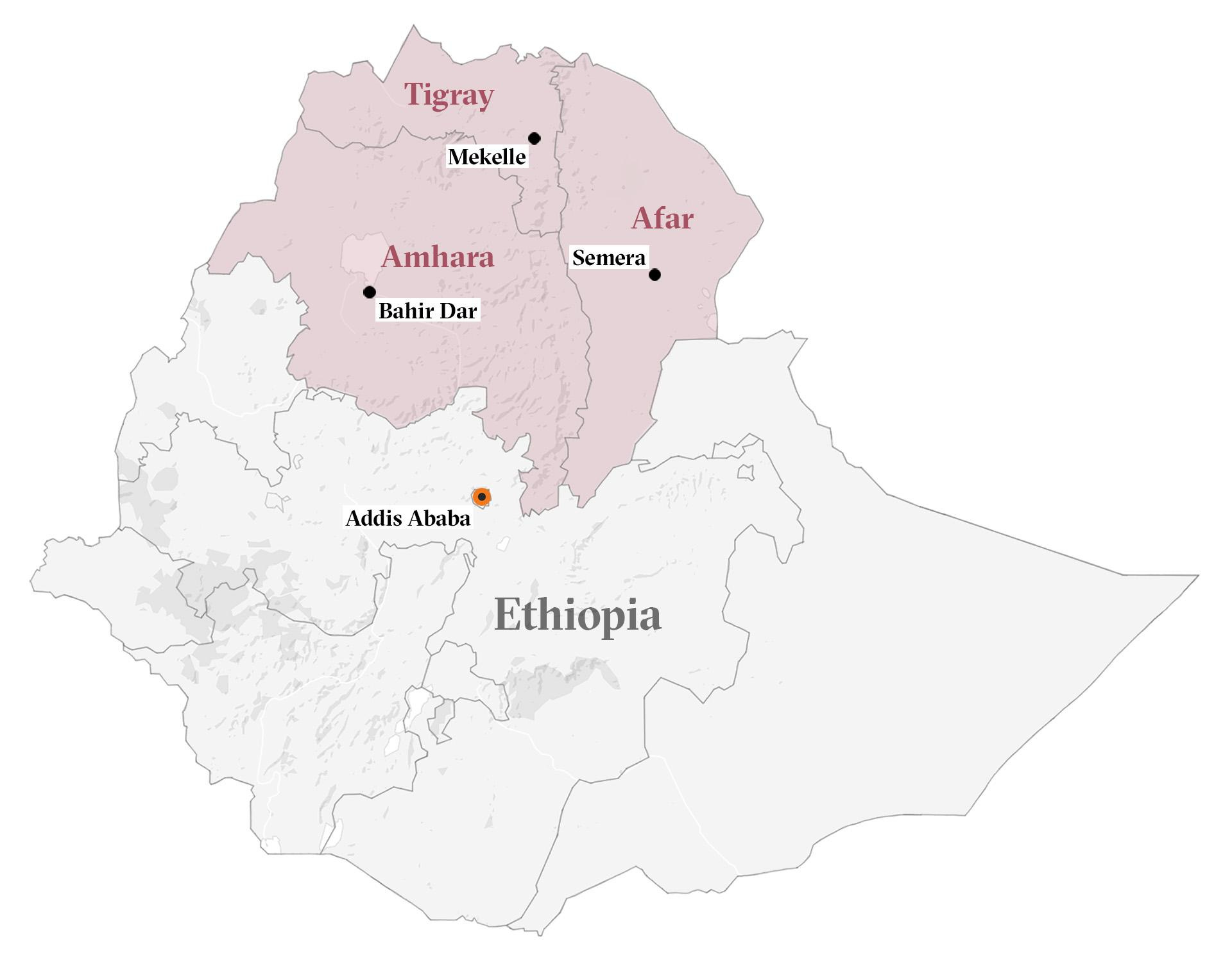
The Tigray People's Liberation Front (TPLF) and allied groups launched a military offensive attack in Tigray, Afar and Amhara in Ethiopia on 23 September 2026. The TPLF says that it started a "defensive war" against the federal government of Ethiopia. Tigrayan Defence Forces (TDF), the military wing of the Tigrayan People’s Liberation Front (TPLF), seized Alula Aba Nega International Airport in Mekelle. Ethiopian Airlines subsequently suspended flights to Mekelle, Axum, and Shire.
A return to civil war in Tigray is now highly likely. The TPLF have declared the African Union-brokered Pretoria Agreement, which ended the Tigray conflict, “effectively dead”, with Debretsion (an Ethiopian politician serving as the chairman of the Tigray People's Liberation Front (TPLF). He was previously the president of the Tigray Region.) having consistently criticised its implementation. The capture of Mekelle’s airport has significantly escalated regional tensions and made headlines in international news.
Seven Ethiopian armed groups, including the Tigray People's Liberation Front (TPLF) and the Amhara Fano National Movement, allied. They aimed at overthrowing Prime Minister Abiy Ahmed’s government. Fano, a coalition of armed groups from the Amhara region, fought to support the federal government against the TPLF during the 2020-2022 Tigray war. The announcement of the Ethiopian Peoples’ Forces Alliance for Survival brought together an ethnically diverse body of groups based across the country, from Tigray in the north to the Somali Region in the south.
From 2020 to 2022, Ethiopia was devastated by a civil war between the federal government in Addis Ababa and Tigray’s regional leadership. The conflict drew in neighbouring regions and foreign troops from Eritrea, leading to a humanitarian crisis that displaced millions and left hundreds of thousands dead.
While a peace agreement paused the worst of the bloodshed in late 2022, it left a lot of the political and territorial disputes unresolved, which is bringing turmoil in the present.
How the Conflict Began
The roots of the crisis lie in Ethiopia’s post-2018 political transformation. The EPRDF(Ethiopian People’s Revolutionary Democratic Front), a coalition dominated by the Tigray People’s Liberation Front (TPLF), ruled Ethiopia from 1991 until 2019 by overthrowing the Derg government in 1991.
The 2014–2016 protests consisted of large-scale demonstrations and civil unrest by Ethiopia's Oromo population, opposing the Ethiopian People's Revolutionary Democratic Front (EPRDF) government's Addis Ababa and Surrounding Oromia Integrated Development Plan.
The 2014 Addis Ababa Master Plan was a controversial plan to expand the boundaries of the Ethiopian capital, Addis Ababa, by 1.1 million hectares into the Oromia Special Zone in April 2014 for urban expansion, industrialisation, and infrastructure. The proposed expansion of the boundaries of Addis Ababa ignited the 2014–2016 Oromo protests beginning on 25 April 2014; to which the government responded by shooting at and beating peaceful protesters.
More widespread strikes and street protests resumed on 12 November 2015; largely led by students in Ginchi (located 80 km southwest of Addis Ababa and encircled by the Oromia region). Protests spread throughout 400 different locales across 17 zones of the Oromia region, and according to Amnesty International 800 of these protestors were killed. On 12 January 2016, after two months of protests, the Oromo Democratic Party said that the plan was “fully terminated” after extensive meetings with government officials who rejected it.
The protests in the Amhara Region began in Gondar in 2016 and quickly spread across the region. It was driven by disputes over Welkait and administrative boundaries. Although the protests were different in character, both movements challenged the dominance of the EPRDF. Protesters faced mass arrests and restrictions on peaceful assembly. Ethiopian security forces used live ammunition during the protests, resulting in more than 1,000 deaths across the two regions. Tens of thousands of people, including citizens, journalists and political leaders, were also arbitrarily arrested.
Subsequently, EPRDF elected Abiy Ahmed as Prime Minister (PM) in March 2018. After becoming prime minister in 2018, Abiy Ahmed sought to replace the ethnically based EPRDF coalition with a single, pan-Ethiopian political party. In 2019, he dissolved the EPRDF and formed the Prosperity Party. But the refusal of the Tigrayan People's Liberation Front (TPLF) to join and become part of the new party highlights the emergence of the future conflict between them.
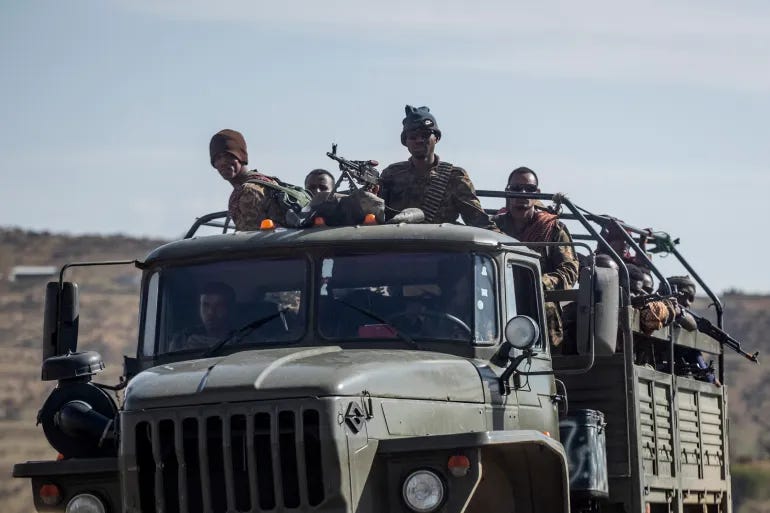
Ethiopian government soldiers ride in the back of a truck near Agula, north of Mekele in the Tigray region of Ethiopia, on May 8, 2021 [Ben Curtis/AP]
Relations between Ethiopia’s federal government and the TPLF worsened because of disagreements over federalism, political authority and constitutional legitimacy. Tigray’s regional leadership conducted its own regional election in September 2020 during the COVID-19 pandemic, which the federal Abiy’s government later declared unlawful. In November 2020, fighting erupted after an attack on federal military installations in Tigray.
In November 2020, war broke out in Tigray between the federal government and the regional government. The Ethiopian National Defence Force (ENDF) and Eritrean Defence Forces (EDF) occupied Tigray's capital of Mekelle, leading the civil war. The TPLF fought a bloody war against Ethiopia’s federal government and its allies in Eritrea and the Amhara militias known as Fano. Tigrayan forces retook the regional capital of Mekelle from the ENDF in June 2021. A month later, Addis Ababa announced the results of a national parliamentary election, which Prime Minister Abiy Ahmed won in a landslide.
The TPLF boycotted the election, and opposition leadership in parliament accused the Abiy government of banning poll observers in some states. In November 2021, Tigrayan troops and allied Oromo militants marched within eighty-five miles of the capital but were forced back north by ENDF forces. The conflict divided Ethiopia along regional and ethnic lines. The Oromo Liberation Army (OLA) fought alongside Tigrayan forces, while Fano and Amhara Regional Special Forces, together with Afar Regional Special Forces, fought alongside Ethiopia’s federal forces.
The Ethiopian war has had a devastating impact on human rights and civil society. The conflict has resulted in mass killings, widespread sexual violence, forced displacement, and the destruction of healthcare and education infrastructure. The UN International Commission of Human Rights Experts on Ethiopia (ICHREE) has documented these violations.
Pretoria: A Fragile Settlement
Following the break-out of violent conflict in the Tigray Region of Northern Ethiopia on 03 November 2020, the Chairperson of the African Union Commission, H.E Moussa Faki Mahamat appointed H.E Olusegun Obasanjo, former President of the Federal Republic of Nigeria, as the AU High Representative for the Horn of Africa on 26 August 2021. The Chairperson subsequently set up a High-Level Panel for peace efforts in Ethiopia. After months of sustained efforts to assist the Parties in finding a political solution to the conflict, the Government of the Federal Democratic Republic of Ethiopia (FDRE and the Tigray People’s Liberation Front (TPLF) convened for their first direct Talks
The Agreement for Lasting Peace through a Permanent Cessation of Hostilities was signed in Pretoria on 2 November 2022 under African Union mediation. Earlier, on 7 September 2022, TPLF chairman Debretsion Gebremichael appealed to the UN for a cessation of hostilities, calling for humanitarian access, the withdrawal of Eritrean forces and the restoration of Tigray’s pre-war borders.
Direct AU-mediated talks between the Ethiopian government and the TPLF began in South Africa on 25 October 2022, for the restoration of peace, security and stability in the Tigray Region. The Pretoria agreement had 15 articles covering objectives, principles, disarmament, demobilisation, reintegration, confidence-building measures, re-establishing federal authority over Tigray, and controlling borders and facilities. It also prescribed transitional arrangements and procedures for monitoring, verification and compliance.
Ten days later, on 12 November, they signed the Nairobi Declaration in Kenya, setting out further arrangements for the disarmament of Tigrayan forces.
Why Is the Peace Breaking Down?
While the agreement ended large-scale conventional warfare, Pretoria was not a comprehensive settlement of every political dispute in the region. The Pretoria Agreement contains several weaknesses. Article 1(2) and Article 3(4) create ambiguity over the scope of restoring constitutional order. Article 3(1) does not establish a clear mechanism for the disengagement and repatriation of Eritrean forces. Provisions on Internally Displaced Persons and Disarmament, Demobilisation and Reintegration also lack clear timelines, while Article 2(e) does not clearly define continental actors’ role in political dialogue.
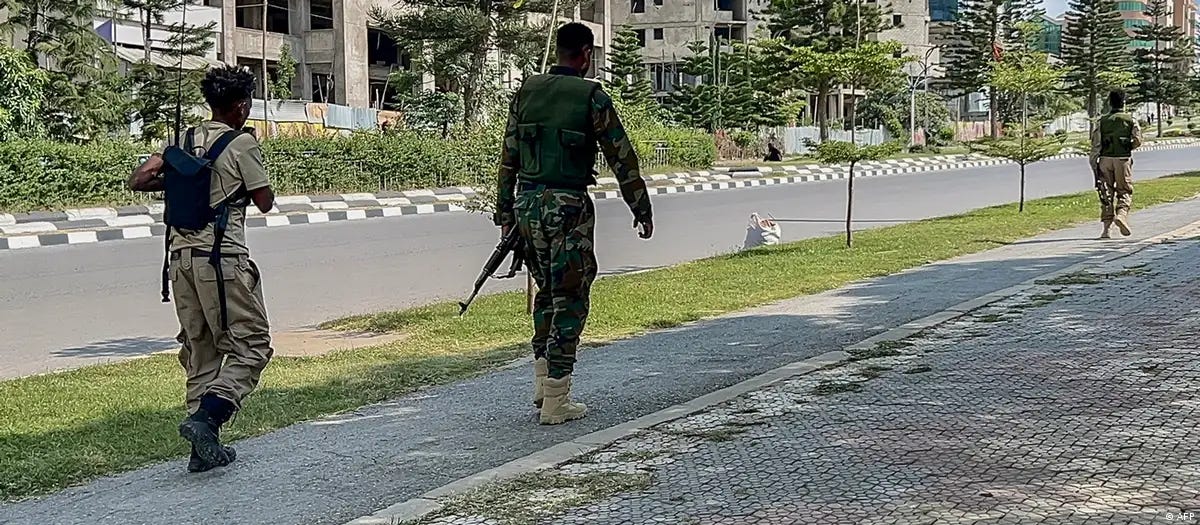
In the months before 22 September, the TPLF was reportedly involved in forced recruitment and increased military preparations. On August 20th the Ethiopian government attacked Mekelle, Tigray’s capital, with fighter jets and drones. The strikes reportedly injured 13 people, including children. From August 24th to August 27th, Tigray was bombed at least once a day. One drone strike in the south on August 26th destroyed a school. This also led to the failure of the peace agreement and led to recent military strikes.
The 2026 Pretoria Agreement Implementation Report (PAIR) reveals systematic failure across virtually all substantive provisions. Research with over 100 participants found that the agreement delivered negative peace while positive peace remains elusive. Ethiopia's failure to fully implement it has triggered renewed clashes between the Ethiopian National Defense Forces (ENDF) and the Tigray Defense Forces (TDF) in occupied Tigrayan territories. These clashes in late January 2026 were followed by ENDF drone strikes that killed at least one person in central Tigray, and the Federal government’s cancellation of all flights to the region a suspension that was lifted and reinstated several times since. The Ethiopian government has also been deploying thousands of its soldiers to Tigray’s borders and across the region, while tensions between Ethiopia and Eritrea are also reaching a new high.
While the African Union verified the disarmament of Tigray Defense Force (TDF) heavy weapons, the process was premature and poorly sequenced. Disarmament was completed without guarantees that occupied territories would be vacated or that Tigray's civilian population would be protected. Reintegration packages of approximately ETB 90,000 (USD 1,300) were deemed grossly inadequate, and female ex-combatants were systematically excluded from reintegration programs and vocational training. The absence of Tigray from the 2026 national election further deepened doubts about whether the region had been fully reintegrated into Ethiopia’s constitutional order.
Due to massive USAID funding cuts, Food aid had declined by over 56% since January 2025, with beneficiaries dropping from 1.66 million to just 726,000 by November 2025. A 2024 study found that starvation was the leading cause of death across all age groups in Tigray between November 2022 and August 2023, accounting for 49.3% of verified deaths, with children under five at particularly high risk. The same 2024 study found that over 300 Internally Displaced People died at Hitsats IDP Camp over eight months.
Regional and International Implications
Jalale Getachew Birru, a senior analyst for East Africa at the Armed Conflict Location & Event Data Project (ACLED), also stressed that the conflict cannot be viewed in isolation.
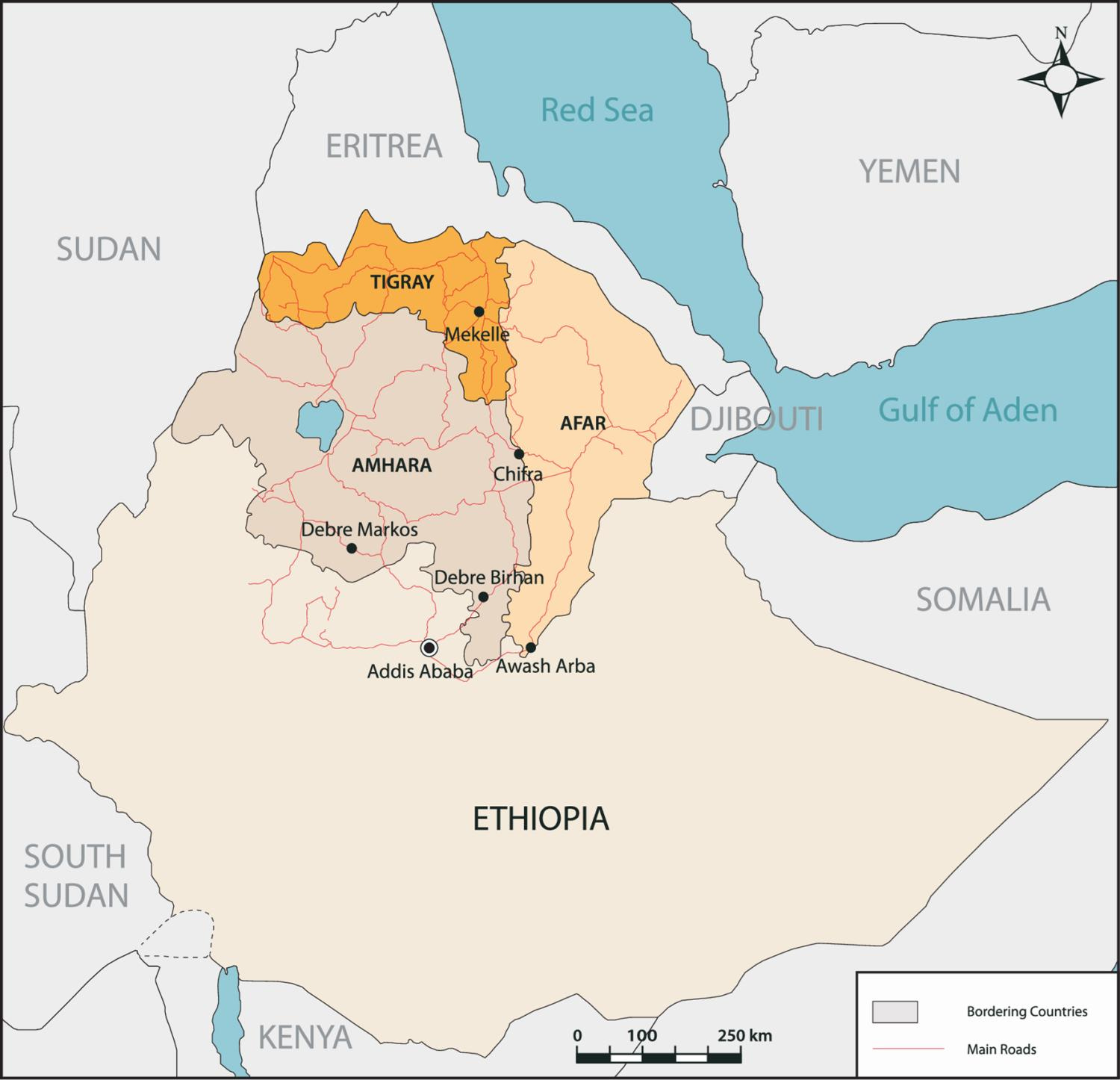
Ethiopia’s renewed Tigray conflict is related to a wider pattern of instability across the Horn of Africa, which involves neighbouring Sudan, Somalia, Eritrea and Djibouti. In Afar (an administrative region in northeastern Ethiopia), fighting threatens the transport corridor to Djibouti, through which much of landlocked Ethiopia’s international trade passes. Beyond Afar lies Eritrea, whose relations with Addis Ababa have deteriorated over Ethiopia’s ambitions for Red Sea access.
Eritrea fought alongside Ethiopian forces against TPLF during the 2020–2022 war. However, Eritrea’s possible involvement in the renewed fighting remains difficult to establish independently. After the war, however, relations between Ethiopia and Eritrea deteriorated. One major source of tension is Ethiopia's pursuit of reliable access to the Red Sea, particularly through Eritrea. Eritrea views Ethiopia's maritime ambitions through the lens of its own sovereignty and territorial integrity.
Army 70 is a TPLF-linked armed unit of several thousand fighters that formed in eastern Sudan after fleeing the 2020–2022 Tigray war, with some reportedly fighting alongside Sudan’s Armed Forces (SAF) against the Rapid Support Forces (RSF). Sudan has been at war since 2023 between the SAF and the RSF. RSF is a paramilitary force led by Mohamed Hamdan Dagalo, commonly known as Hemedti, and has been fighting Sudan’s regular army. Martin Plaut, a journalist and Horn of Africa expert and former Africa editor of BBC World Service News, argues that "The Ethiopians are on the side of the RSF and Hemedti." "There has been strong evidence that there is a base in western Ethiopia which is supplying and training RSF fighters."
The Bab el-Mandeb Strait, one of the world’s most important shipping choke points, connects the Red Sea with the Gulf of Aden and the Indian Ocean. Eritrea and Djibouti lie on its western side, Yemen on the eastern side. The war in Yemen has already shown disruption of international shipping in the Red Sea. For Ethiopia, the instability is significant because the country depends heavily on access to ports and trade routes through the Red Sea, particularly via Djibouti. The ongoing instability will critically impact its economy and people.
Conclusion: Peace Under Pressure
Tigray suffers from political fragmentation and repression, including crackdowns on media and the controversial realignment of former leaders with the federal government. The federal government’s proposal to hold a referendum on contested areas was rejected by the Tigray Interim Administration as unconstitutional.
The war caused mass displacement, famine-like conditions and the collapse of essential services, with researchers estimating that hundreds of thousands of people died through direct violence, hunger and the destruction of healthcare systems.
Furthermore, the conflict has been absorbed into a volatile global proxy war, where competing alliance systems involving the Middle East and the US-Iran war threaten to turn the Horn of Africa into a wider regional battlefield. Its future depends on more than renewed ceasefire diplomacy. Ethiopia needs credible security guarantees, the resolution of Western Tigray’s status, safe returns for displaced people, political inclusion and accountability for abuses.
This looks like a must read.