


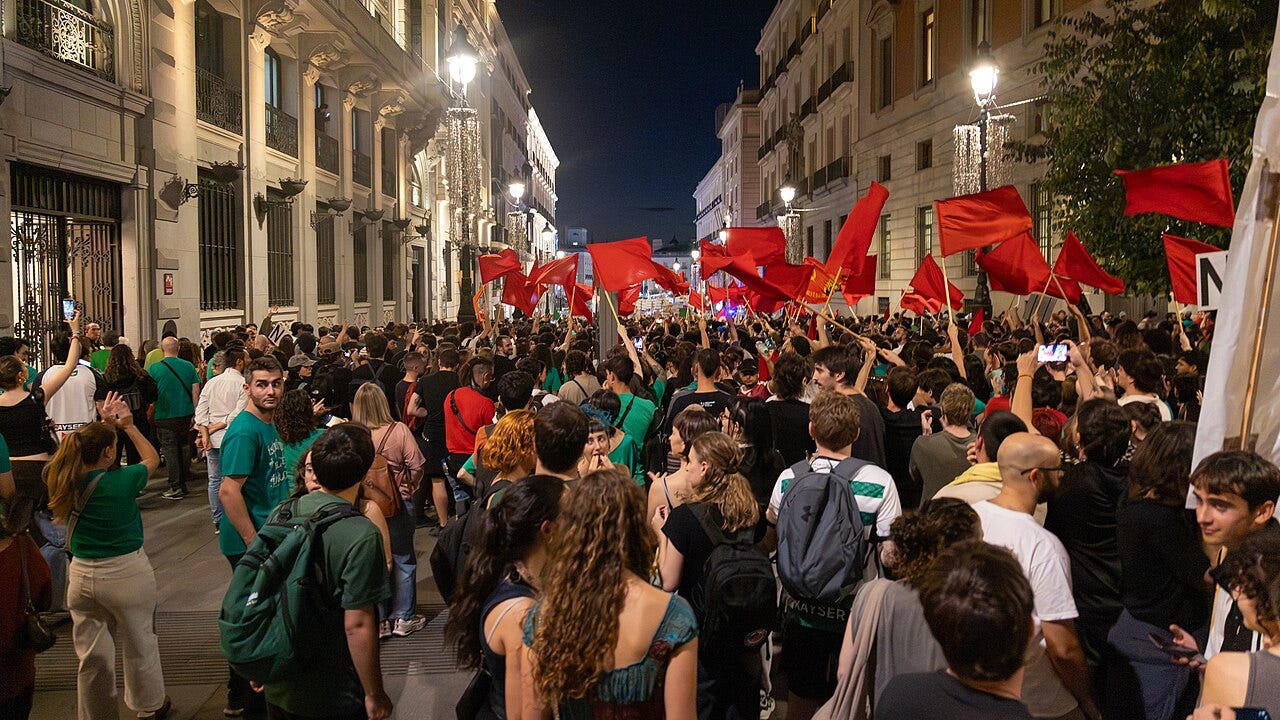
Photo: Barcex / Wikimedia Commons, CC BY-SA 4.0. Photograph of a public education march in Madrid, Spain, 14 Oct, 26
Recent youth-led protests across Asia and Europe show how digital fluency, social and economic consciousness, and frustration with systemic inequalities can grow into wider political movements. Generation Z (Gen Z) has emerged as a significant force in contemporary political activism. Protests over school conditions in France, living costs in Spain and Portugal, and exam integrity in India share a common ground of protest, making young people believe that institutions do not treat them fairly. Whether this brings institutional and governance reform or is suppressed depends on political transparency, access to digital networks, and the state’s capacity to repress dissent.
The clearest evidence is South Asia, where student-led mobilisation has challenged not only specific policies but the legitimacy of established institutions. The 2024 Bangladesh Quota Reform Movement, which largely favoured descendants of freedom fighters from the 1971 Liberation War over civil service job quotas, led massive student protests. This contributed to the fall of the government of Prime Minister Sheikh Hasina. In Nepal, youth-led demonstrations over social media restrictions and wider anger over corruption and nepotism led to massive unrest. With curfews, the army on the streets, and dozens dead, the movement later culminated in Prime Minister K. P. Sharma Oli’s resignation.
In India, even though there was no visible regime change, young people have also protested against institutional failures and demanded greater accountability. In 2026, the Cockroach Janta Party (CJP) movement grew from an online satire campaign into a youth-led protest, as students demanded answers over a leak of the National Eligibility cum Entrance Test (Undergraduate) examination paper. The protest also highlighted wider concerns about the education system. It intensified pressure on the government, leading to the resignation of Union Education Minister Dharmendra Pradhan. Months later, after an Indian Express investigation found that there were massive voter roll deletions under the Election Commission of India's Special Intensive Revision (SIR) exercise, it uncovered critical technical, procedural, and systemic flaws. The Gen Z subsequently demanded the resignation of the chief election commissioner, but the protesters were detained, and the designated protest sites were reportedly declared off-limits.
Youth discontent is not only confined to the South Asian region but is also visible across Europe. Students and other protesters have mobilised around rising living costs, education funding and dissatisfaction with government priorities. Across Italy, Spain, Belgium, and Portugal, a familiar pattern of political discontent is visible. According to the latest data on the Euro area’s annual inflation published by Eurostat, Spain is the most affected, as local energy cost spikes drove the number up to 5%. Belgium reached 4.69% (the highest level since 2023), and Italy reached 4.2%. Meanwhile, France stayed up at 3.4% but still lower than most of its neighbours, and Germany rose to 3.3%.
The economic statistics show that the cost of living has revived an older protest movement. Following weeks of student protests in France, the country's Yellow Vest movement called for nationwide protests over the cost of living. The country's Yellow Vest movement, which eight years ago staged street protests against Macron's government over planned fuel tax hikes, had called for the "yellow and youth" demonstrations. More than 600 demonstrations were planned across France, according to a website set up by organisers.
The protest turned violent as reports cited that a 17-year-old boy had his right hand blown off by a crowd-control grenade in the southern city of Saint-Étienne. Some groups of masked protesters smashed shop windows, looted supermarkets and luxury stores, set parked cars on fire, and vandalised town halls and public buildings. A fire badly damaged a historic town hall in Limoges, while a tourist office in Lyon was set ablaze. Protesters also clashed with police, who used tear gas and water cannons. However, not all demonstrators took part in the violence; many joined the nationwide marches to protest inflation and the rising cost of living.
In Italy, the grievance is less about prices than about public spending priorities. Thousands of students across Italy have taken to the streets to protest Prime Minister Giorgia Meloni's policies, demanding increased investment in education and school infrastructure, and a reduction in military spending. Student protests across Italy escalated into clashes, vandalism, and the burning of trash cans and electric scooters. Turin, Verona, Genoa, Venice, and other cities reported unrest. Education Minister Giuseppe Valditara condemned the violence as “political hooliganism,” while Deputy Prime Minister Matteo Salvini labelled protesters “criminals and lawbreakers.” As students prepare for a planned general strike on October 30, the greater political outcome is still yet to come.
Beyond the larger economies, smaller states show an ecological reason for youth demonstration. The Flamingo movement in Albania began with protests against a Kushner-linked coastal tourism project that critics feared would damage flamingo habitats in the Vjosa-Narta protected area near Vlora. It later expanded into demands for action on alleged corruption, rising education costs and the cost of living. Additionally, in Portugal, Student associations from several universities in Lisbon staged a protest outside the Government headquarters at Campus XXI against proposed tuition fee increases from 2027/2028. They opposed changes affecting undergraduate, technical, and selected master’s programmes, demanding continued tuition fee limits.
Digital mobilisation has been an integral factor of youth-led protest. Digital activism has produced different political outcomes across countries. In Sri Lanka, South Korea and Nepal, public mobilisation helped drive political transitions and demands for institutional reform. In Iran, Myanmar and Kazakhstan, state authorities used repression to contain dissent. This proves that the impact of digital mobilisation depends on political openness, access to digital networks and the government’s ability to suppress opposition.
Political leaders and parties have a significant role in channelling Gen Z’s political engagement towards constructive outcomes. Those who meaningfully address young people’s concerns and secure their trust can gain substantial political support. The influence of youth participation was evident in Zohran Mamdani’s 2025 campaign for mayor of New York City. Initially an underdog, Mamdani appealed to younger voters through his promise of a more affordable city, his criticism of political corruption, and a digitally focused campaign that distinguished him from his more established rivals. His electoral success demonstrated how effectively engaging young voters can translate their political energy into electoral support.
As reported on the European Youth Portal, More than six in ten (64%) young EU citizens express their intention to vote in the upcoming European elections, while 13% indicate they will not vote – despite being eligible. Europe’s next electoral cycle will test whether young voters convert their current political discontent into ballots. Spain’s unemployment rate, 10.0% in August, while Italy carries the heaviest debt of the large economies and has the longest-lasting government. The test for governments is whether they absorb youth discontent or merely contain it.