


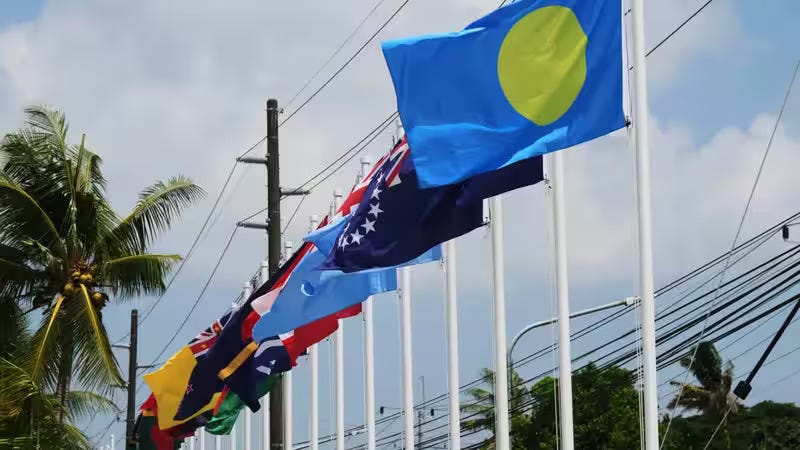
Credits: (AP Photo)
The 55th Pacific Islands Forum (PIF) Leaders Meeting was held in Koror, Palau. The Pacific Island Nations consist of three major groups of islands named Polynesia, Micronesia and Melanesia. The theme of the meeting was BELAU (“Building Economies: Life. Action. Unity”). This indicated the vision of cooperative regional solidarity on issues of climate change, economic resilience, and maritime security. The week-long summit showcased intense political tension in the region as several leaders pulled out of the Pacific Islands Forum leaders’ meeting in Palau at the eleventh hour. The Prime Ministers of Fiji, Vanuatu, Samoa and the Solomon Islands, along with the President of Kiribati, were seen to be absent from the forum meeting.
Regional consensus within the 18-member PIF is inherently seen as fragile, with disagreements over maritime security and major-power alignments. Only three Pacific countries in the forum, Palau, Tuvalu and the Marshall Islands, are seen to maintain formal diplomatic relations with Taiwan. China regards Taiwan as part of its territory and has gradually persuaded several countries to switch diplomatic recognition from Taipei to Beijing. Ten days prior to the summit, Chinese authorities issued a travel warning to Palau, threatening its tourism sector, which historically depended on China for 40% of its GDP.
Taiwan and its three diplomatic allies in the South Pacific signed a joint statement pledging to work more closely for the betterment of the region and deepen healthcare cooperation with Palau in digital healthcare systems and professional training as Foreign Minister Lin Chia-lung concluded a visit to Palau.
Pacific Island leaders expressed concern about China’s Pacific missile test at their annual summit, though Nauru formally dissented, in a meeting largely overshadowed by Beijing’s objections to Taiwan’s presence. Summit host and Palau President Surangel Whipps Jr. said that China’s intercontinental ballistic missile (ICBM) test in July, Beijing’s first known launch in the Pacific since September 2024, was passed over several island nations without adequate warning.
Leaders endorsed the BELAU Declaration for Urgent and Inclusive Climate Action to Keep 1.5°C within Reach, which calls for stronger international action on climate change, greater recognition of the ocean-climate connection and an accelerated transition away from fossil fuels towards renewable energy. Leaders also committed to accelerate the transition away from fossil fuels and towards a 100 per cent renewable energy future for the Blue Pacific. They backed the accelerated development of a Regional Renewable Energy Transition Strategy and implementation of the renewed Framework for Energy Security and Resilience in the Pacific, known as FESRIP 2.0.
Leaders called for effective delivery of Article 9 of the Paris Agreement and the New Collective Quantified Goal on climate finance, including grants and other non-debt-creating instruments with simplified and direct access arrangements. They also called for urgent action to close the adaptation finance gap, including responding to the UN climate process call to at least triple adaptation finance.
Australia has joined hands with Pacific nations to strengthen regional security, amid increasing transnational and organised crime. Prime Minister Anthony Albanese and Pacific leaders initiated Waqa Moana. It is a Pacific-led maritime security initiative to counter illicit drug trafficking in the region. This will help to get actionable intelligence into the hands of Pacific police forces and operational responders. Prime Minister Albanese has announced a $600m package of support for crime regulation. Albanese said that the “Pacific is our home and our family” and it is in Australia’s interests to work with Pacific partners.
Pacific island states have outlined their own non-military-related security agenda, including economic integration, climate action, ocean governance, technology, connectivity and institutional reform through this meeting. The matters which reflect responsibility are protecting peace and security architecture, advancing the 2050 International Engagement Strategy, deepening regional integration, preparing for COP31, and ensuring that partnerships continue to serve Pacific priorities.