



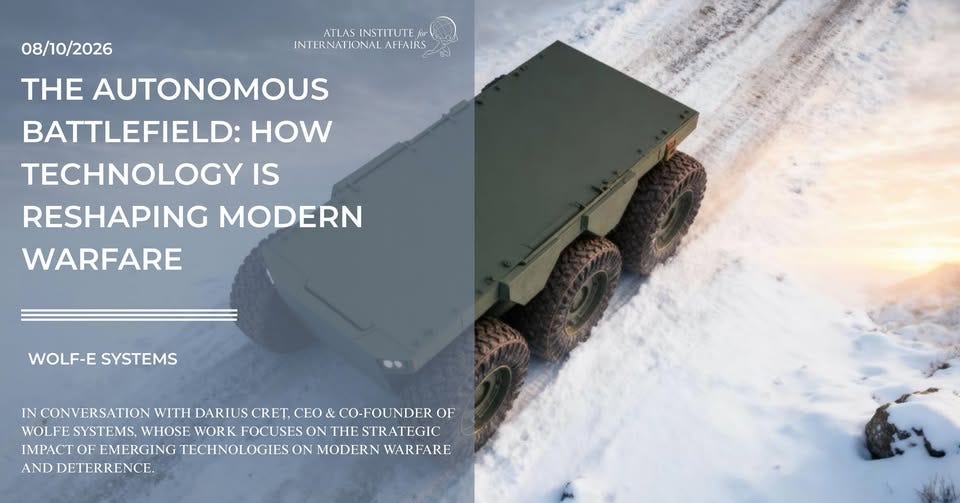
The Atlas Institute for International Affairs organised a webinar titled “The Autonomous Battlefield: How Technology Is Reshaping Modern Warfare” on 8 October 2026. Darius Creț, co-founder and CEO of Wolf-e Systems, a Romanian defence technology company specialising in unmanned ground and surface vehicles, discussed how emerging technologies are transforming contemporary warfare. His presentation went beyond drones and artificial intelligence to examine the changing economics of warfare, electronic warfare, defence procurement, supply-chain vulnerabilities and the industrial capacity required to sustain military innovation.
Creț placed the Ukraine–Russia war within the history of asymmetric warfare, arguing that the war dynamics visible in Ukraine are not entirely new. He cited the Afghanistan war as an earlier example, where the Taliban, despite possessing fewer resources and much less sophisticated military equipment than the United States and its allies, developed effective responses and tactics such as dispersion, use of networks, and improvised explosive devices (IEDs) as an asymmetric approach.
For Creț, the central lesson from these conflicts is that military advantage is not about technological sophistication or massive spending. It is about how dispersed forces and networks can provide an edge to weaker actors to tackle a conventionally superior adversary. He linked this experience to Ukraine, where networks, drones and rapidly evolving technologies are being used to confront a more powerful opponent.
The Economics of Asymmetric Warfare
A central theme of the presentation was the widening economic imbalance between inexpensive offensive systems and costly defensive platforms. Creț compared the cost of inexpensive interceptor drones with that of Shahed-type drones, while noting that conventional missile interceptors like the Patriot PAC-3 are significantly more expensive. The comparison highlights the growing cost asymmetry between low-cost defensive systems and the more expensive platforms traditionally used to counter incoming threats. He argued that, when low-cost interceptor drones are properly integrated with radar and operated by trained personnel, they could achieve hit rates of up to around 90% against Shahed-type threats. This would offer a better and more sustainable cost-exchange ratio than traditional missile-based air defence.
The same cost asymmetry can be seen across different domains. Creț cited Operation Spiderweb, in which Ukrainian forces used inexpensive FPV drones to strike 41 aircraft across four Russian airbases. At sea, he highlighted that Ukrainian unmanned surface vessels (USVs), including the Magura V5 and Sea Baby, had destroyed roughly one-third of Russia’s Black Sea Fleet. This pushed Russian naval assets away from Sevastopol, allowing the reopening of Ukrainian shipping lanes.
The examples highlight the changing cost structure of warfare. The ability to rapidly produce low-cost weapons at scale and adapt them to changing battlefield conditions can create an advantage for smaller and medium-sized militaries, allowing them to impose disproportionate costs on a more powerful adversary.
From Drones to Networks
Creț argued that fully autonomous combat systems remain a possibility, but said he had not yet seen them work independently in actual combat. Instead, unmanned systems are already being used across air, land, sea, electronic warfare and space. In the air domain, these include FPV strike drones, loitering munitions, interceptor drones and long-range strike drones. He noted that FPV drones account for a significant share of Russian battlefield losses, illustrating their growing role in combat.
On land, UGVs are being used extensively for logistics, resupply and medical evacuation, as well as mine-laying, breaching, explosive ordnance disposal and armed missions. Creț highlighted the rapid expansion of UGV operations in Ukraine, with monthly missions rising rapidly in August. He also noted that large quantities of UGVs had been contracted by Ukraine since January 2026. Their importance lies not only in their operational functions but also in their ability to keep soldiers out of the kill zone during logistics and evacuation missions.
At sea, Creț said the most common use of USVs remains strike missions, but Ukraine is developing new roles for them as drone carriers or motherships. Sea drones can transport UGVs towards the shore and deploy them on land, or serve as platforms from which other unmanned systems can be launched. He described one example in which a USV transported and deployed an armed UGV after the systems lost their signal because of electronic warfare.
Creț connected these developments to what he described as an increasingly transparent battlefield. Satellites, high-altitude ISR platforms, aerostats, radars and acoustic sensors provide persistent surveillance, making it increasingly difficult to conceal forces and equipment. Ukraine’s Delta platform contributes to this picture by bringing together different sensor inputs, including ISR, radar and acoustic data, to provide a broader view of battlefield activity. He also noted that satellite communications and ISR support are substantially provided by Ukraine’s allies, given the lack of its own satellite constellation.
The wider significance, according to Creț, is that modern warfare depends increasingly on interconnected networks rather than on individual weapons. Drones may not necessarily be the most powerful weapons available, but their effectiveness comes from how well they are integrated into a broader network of sensors, software, communications and military units. AI can further accelerate this process by helping to close the sense–decide–strike–assess loop within minutes: sensors identify what is happening, software fuses the information and supports decision-making, a suitable weapon or platform conducts the strike, and subsequent sensing assesses its effect. In this environment, Creț argued, defeating a network increasingly requires another network capable of operating across the same interconnected battlespace.
AI, Electronic Warfare and the Kill Chain
Creț stressed that the significance of Artificial Intelligence (AI) lies not simply in autonomous targeting, but in its ability to accelerate the wider kill chain. The process begins with sensing, followed by decision-making, striking and assessment. Drones, satellites and other sensors continuously observe the battlefield, while software can fuse information and help commanders identify appropriate responses. AI can therefore help close the loop from sense to decide, strike and assess in minutes.
This does not mean that individual drones are independently conducting entire combat operations. Rather, AI functions act as a force multiplier within a broader network of sensors, command-and-control systems and weapons. Ukrainian drones, he argued, are highly effective because they operate within decentralised networks capable of adapting rapidly to battlefield conditions.
Electronic warfare also advances technology adoption. Jamming can disrupt radio links and satellite navigation, forcing systems to rely on frequency hopping, alternative control methods, fibre-optic connections or increasingly autonomous guidance. Creț noted that although swarm technology is frequently discussed, Ukrainian commanders have not yet found fully autonomous swarms sufficiently responsive for widespread battlefield use.
The technological transformation of warfare is also changing how military equipment is procured. Creț highlighted Ukraine’s Brave1 platform as an example of a more decentralised approach. Rather than relying entirely on centrally determined procurement, Brave1 functions like a marketplace where companies offer their technologies and individual military units can select what they need. Each battalion receives a certain allocation of tokens, which it can use to acquire specific drones and other systems.
The platform also allows units to choose how different technologies are integrated. For example, a battalion purchasing a particular drone can select a compatible command-and-control system rather than being limited to the default option. This gives soldiers greater flexibility to use systems they are already familiar with and creates numerous combinations between drones, platforms and software. Creț contrasted this model with procurement systems in Europe and the United States, emphasising its decentralised nature and the ability of frontline units to influence the technologies they receive.
Supply Chains and Industrial Capacity
However, rapid innovation does not remove the importance of industrial capacity. Creț identified supply chains as one of the main problems facing the defence industry, drawing on his experience at Wolf-e Systems. The company has faced difficulties procuring hub motors for its UGVs because European industry lacks sufficient access to the magnets required for their production. According to Creț, these magnets are largely sourced from China, leaving European defence manufacturers heavily dependent on Chinese components. The example shows how dependence on a seemingly small component can expose wider vulnerabilities in defence production.
Creț also stressed that new manufacturing technologies should not be mistaken for a substitute for industrial capacity. The ability to produce drones and other systems rapidly still depends on reliable component supply, manufacturing infrastructure and technical expertise. His broader argument was that defence innovation requires not only new technologies but also the industrial base and supply chains capable of producing and sustaining them at scale.
The asymmetry in industrial capacity cuts both ways. Creț contrasted the eight US shipyards, of which only half are used for military purposes, with around 300 shipyards in China, where ships leaving the shipyards are required by law to meet dual-use standards. For Creț, this illustrates a broader point: industrial capacity itself is a form of deterrence. Even systems that are cheap and relatively simple to produce, including 3D-printed drones, still depend on sophisticated industrial capacity, supply chains and skilled workers.
This also raises a dilemma for defence planners: whether to invest in sophisticated platforms such as the F-35 or in the large numbers of cheap drones seen in Ukraine. Since cheap drones can become obsolete within months, Creț argued that countries need the ability to surge production when required, rather than simply stockpiling them. Maintaining this capacity requires active production lines supported by multi-year contracts, dual-use supply chains and a skilled workforce. Critical inputs such as magnets, along with engineers capable of developing new drone technologies, are therefore essential to sustaining defence-industrial capacity.
The Future Battlefield
Creț identified an emerging dilemma for military planners: whether to prioritise sophisticated platforms such as the F-35 or inexpensive systems like those being deployed in Ukraine. His argument suggests that the answer is not necessarily one or the other.
Cheap drones can be rapidly produced, adapted and replaced, but they can also become obsolete within months. At the same time, sophisticated platforms remain necessary for dealing with high-speed and technologically advanced threats that inexpensive systems cannot easily counter. Future militaries will therefore need to integrate both high-end capabilities and low-cost, rapidly iterated systems within a resilient defence ecosystem.
The central lesson from Creț’s presentation is consequently broader than the rise of autonomous weapons. Modern warfare is increasingly shaped by the interaction between technology, economics and industrial capacity. Low-cost drones can alter the cost-exchange ratio; AI can compress the kill chain; electronic warfare can accelerate the demand for autonomy; and decentralised procurement can shorten the path from innovation to battlefield deployment. Yet none of these developments removes the need for resilient supply chains, skilled workers and manufacturing capacity.
In this emerging environment, industrial capacity becomes a component of deterrence itself. The ability to produce, adapt and scale military technology may matter as much as possessing the most sophisticated platform at any given moment. The autonomous battlefield is therefore not simply about machines operating without humans. It is about how quickly military organisations, industries and states can adapt to a battlefield in which technology, software and the economics of warfare are changing simultaneously.