


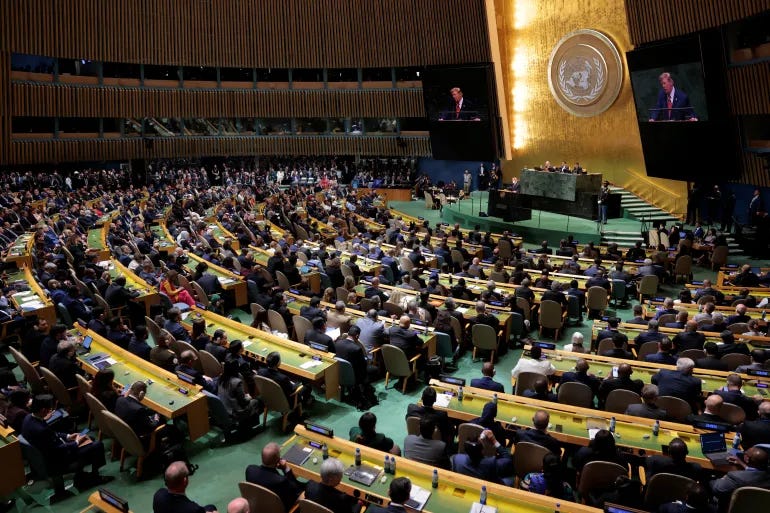
The 81st UN General Assembly considers long-standing calls to reform the UN Security Council, September 22, 2026 [Kylie Cooper/Reuters]
“If the United Nations is to survive, those who represent it must bolster it; those who advocate it must submit to it; and those who believe in it must fight for it.” Norman Cousins, a prominent journalist and peace advocate, uttered these words in 1956. They continue to resonate today, for the UN is hardly a perfect institution.
The UN has grown from 51 founding members in 1945 to 193 members today, representing almost the entire international community. Yet its core decision-making bodies, especially the UN Security Council, remain frozen without reforms in a post–World War II configuration, as decision-making authority over international peace and security remains concentrated in a 15-member Security Council dominated by five permanent veto-wielding states.
The 81st session of the United Nations General Assembly (UNGA 81) is themed as Restoring Trust, Managing Transformation: A United Nations That Delivers for All. Formally opened on September 8, 2026, under the leadership of Dr. Khalilur Rahman, the Foreign Minister of Bangladesh, which marks a significant moment for Bangladesh's diplomacy. He succeeded Germany's Annalena Baerbock, who presided over the 80th session.
There are currently 65 active armed conflicts in the world, the most since 1946. Two permanent members of the UN Security Council, Russia and the United States, have started wars in violation of the UN Charter. Meanwhile, tech experts are now warning that AI might wipe out humanity. Accelerating climate change also poses an existential threat.
At the 81st session, the UN appears diluted in authority and increasingly unrepresentative of a multipolar world. Major regions across continents such as Africa, Latin America and large parts of Asia lack permanent representation, making the Security Council appear anachronistic and unrepresentative. This article examines the Global South's growing demand for a more representative multilateral order to ensure the effectiveness and legitimacy of the UN in the new world order.
UNGA 81: A Global South Agenda
At UNGA 81, Global South states forwarded an agenda anchored in three interconnected themes: resolving devastating conflicts affecting developing countries; securing development, debt relief, and climate finance; and reforming global governance institutions. Global military spending has approached $3 trillion, even as development assistance has fallen sharply and progress on several Sustainable Development Goals (SDGs) has stalled.
The United Nations Office for South-South Cooperation’s engagement at the eighty-first General Assembly sought to elevate South-South and triangular cooperation as essential modalities for delivering development impact, advancing the Sustainable Development Goals by launching South-South Galaxy+, and achieving other internationally agreed development goals. The launch of the Global Alliance for South-South and Triangular Cooperation on the United Nations Day for South-South Cooperation celebration on 11 September, following the opening of the 81st Session of the General Assembly, was a key milestone, underscored in the subsequent engagements.
Equitable decision-making and equitable development are the need of the hour. Regional conflicts trigger civilian displacement and food insecurity, which rapidly escalate into severe debt and development pressures for vulnerable economies. Across West Asia, escalating conflict threatens some of the world's most important energy and trade routes, including the Strait of Hormuz and the Bab el-Mandeb.
For Africa, Security Council reform set the agenda for the week. Kenya’s President William Ruto told the Assembly that “the equality proclaimed in this assembly ends at the doors of the Security Council.” Nigeria, one of Africa’s 54 states which together account for more than a quarter of UN membership, reiterated the Common African Position, calling for two permanent seats with veto rights and five non-permanent seats. Africa's under-representation on the Security Council has become increasingly difficult to defend. Even Germany now explicitly supports stronger African representation.
Ruto noted that African countries borrow at rates two to four times higher than those paid by developed economies. Ghana’s President John Mahama launched the final report of the Accra Reset, A Sovereign Future for Health, which urges Global South countries to take ownership of their health systems under the principle of “no ownership without control.” African nations called for a fair share of decision-making power in the institutions shaping their future.
The UNSC and its Reform Issues.
The Security Council's five permanent members (P5) the US, Russia, China, the UK and France still wield veto power, allowing narrow national interests to override collective security imperatives.
Speaking at the recent BRICS Summit in New Delhi, United Nations Secretary-General Antonio Guterres backed the demand from the Global South to expand the UN Security Council, which, he said, will help “bring balance and equity to global systems and institutions”. He also underlined that India has been at the forefront of this demand. Emphasising that today’s economic, demographic and geopolitical realities are not those of 1945, Guterres said that “the institutional structures must reflect it”.
Under the United Nations (UN) Charter, the Security Council’s primary responsibility is the maintenance of international peace and security, as provided under Article 24(1). Unlike the General Assembly, it can, in principle, take decisions that are binding on all members of the UN. The Council meets throughout the year, mainly to consider armed conflicts and other situations or disputes where international peace and security are threatened.
It is empowered to order mandatory sanctions, call for ceasefires, and authorise military action on behalf of the UN. The Council also, with the General Assembly, has a role in admitting new members to the UN (Article 4(2)), appointing the Secretary-General, and electing judges to the International Court of Justice (ICJ). It has also assumed certain other roles not specifically laid down in the Charter, such as the self-conferred role of choosing judges and prosecutors for ad hoc war crimes tribunals, giving the Council a lot of power and creating an unrepresentative instrument of great-power politics.
On 3 November 1950, the General Assembly adopted resolution 377 A (V), which was given the title “Uniting for Peace”. The resolution was established in response to the inability of the Security Council to address the Korean War. The most important part of resolution 377 A (V) is section A, which states that where the Security Council, because of lack of unanimity of the permanent members, fails to exercise its primary responsibility for the maintenance of international peace and security, the General Assembly shall seize itself of the matter.
The Palestinian question has remained unresolved till date, with millions suffering. The Ukraine war continues. Gaza continues to demonstrate the gap between international legal principles and enforcement. Climate commitments routinely outpace implementation. The SDGs remain seriously underfinanced, and the institutional architecture remains substantially rooted in 1945, questioning the framework of the institution. Nations’ sovereignty and international law are violated by the intervention of the major P5 members across the world.
For example, the U.S.-led invasion of Iraq in 2003 and its military intervention in Afghanistan in 2001 showcased how great-power military action can raise questions about state sovereignty, the limits of international law and the role of the UN. Also, UN peacekeepers deployed to conflict-affected regions have multiple times arrived after the most intense hostilities had subsided and a lot of casualties were reported.
In Darfur, Sudan, for instance, delays in the international response allowed mass atrocities to continue. The Darfur case demonstrates the failure of the UN Security Council to act quickly and decisively. Despite evidence of massive human rights abuses, its response remained limited to resolutions, investigations, threats of sanctions and support for an African Union force. Sovereignty concerns and the veto power of P5 members, particularly China, constrained stronger collective action.
Similar failures of international peacekeeping and protection were evident during the genocides in Rwanda and Srebrenica. A lack of resources and a lack of the commitment necessary to prevent genocide constituted the overriding failure behind what happened in Rwanda in 1994. The United Nations Assistance Mission for Rwanda (UNAMIR) was slow to be set up, suffered from administrative difficulties and lacked sufficient troops and equipment, said Ingvar Carlsson, the Chairman of the independent inquiry into the actions of the United Nations during the 1994 genocide.
Following major failures in peacekeeping during the 1990s, including the genocides in Rwanda and Srebrenica and the crisis in Somalia, UN Secretary-General Kofi Annan established the Panel on United Nations Peace Operations, chaired by Lakhdar Brahimi. The panel examined why the UN had failed to protect civilians and prevent atrocities. Annan’s report openly acknowledged these failures, accepting that the UN and the wider international community shared responsibility for not acting effectively to prevent the genocide and protect vulnerable populations.
The UN continues to reflect realist principles within a broader liberal institutional order. This tension has contributed to stagnation in global governance, highlighting the need for institutional reform and renewal to make multilateralism more effective and results-oriented. The 2005 World Summit Outcome (A/RES/60/1) called for negotiations on Security Council reform to continue in the General Assembly, calling for an expansion of the Council to make it more broadly representative, efficient and transparent, but there has been no major change in the system.
Attempts to reform the Security Council have focused primarily on membership expansion and veto modification, but removing or restricting the veto requires amending the UN Charter, which itself requires the unanimous approval of the P-5, who refuse to voluntarily surrender their privilege as it harms their national interest. Nominations for permanent seats trigger intense opposition from regional neighbors, such as Pakistan opposing India, Argentina opposing Brazil, and several European states resisting Germany.
Who Funds the United Nations?
The United Nations is financed through two primary mechanisms: first are mandatory assessed contributions accounting for about 45% of total funding, and second is voluntary contributions, which account for roughly 55%. Just nine countries, namely the United States, Japan, Germany, the United Kingdom, France, Italy, Canada, Spain, and China, combine to pay roughly 75% of the UN’s total core operating budget. The United States is the largest single contributor to the organisation, paying up to 22% maximum for the regular budget and 25–27% of overall peacekeeping costs.
As UN Programs and Funds rely on voluntary contributions, their budgets are chronically uncertain, which forces agencies to dedicate significant effort to ongoing fundraising rather than core operations. For instance, at the end of 2006, member states owed the UN $2.3 billion in unpaid arrears, with the United States accounting for 43% of that total debt. This financial dependency grants "big payers" an effective stranglehold over the UN's operational capacity, creating a dependency chain for developing nations that rely on UN assistance.
Financial leverage directly reinforces U.S. hegemony within the UN system and broader international governance. As both the largest financial contributor and a permanent Security Council member with veto power, the U.S. possesses disproportionate capacity to direct, enable, or block UN initiatives according to its national interest, often operating as a unipolar hegemon. This financial dominance is even more structural in affiliated institutions like the World Bank and the International Monetary Fund (IMF).
Conclusion: Future Ahead
Countries including China, Japan, Türkiye, Morocco, Bahrain, Ethiopia, Kazakhstan and the Philippines promoted South-South and triangular cooperation at the 81st General Assembly. Their initiatives focused on digital transformation, development finance, science, regional integration, green industrialisation, and technology-sharing.
More than eight decades after its establishment, the United Nations remains an important institution of international cooperation, but its limitations have become increasingly difficult to ignore. Its core challenge is the persistent gap between its ambitious founding goals and its operational capacities.
As former U.S. Ambassador Henry Cabot Lodge Jr. succinctly observed, "This organisation is created to prevent you from going to hell. It isn't created to take you to heaven". The basic problem for the UN as the overseer of international security was and remains simple: how to deal with conflicts, be they between or within states, without offending national sovereignty.
The UN cannot become the “definite guaranty of peace” that Woodrow Wilson had envisioned for the League of Nations. As long as the nation-state remains the basic form of political organisation, national interests continue to shape state behaviour, and governments remain responsible for the welfare of their citizens, the UN will have limited ability to act independently. In this sense, the UN remains fundamentally an instrument of its member states, even though many contemporary security threats no longer originate primarily from states but from internal conflicts and transnational groups.