



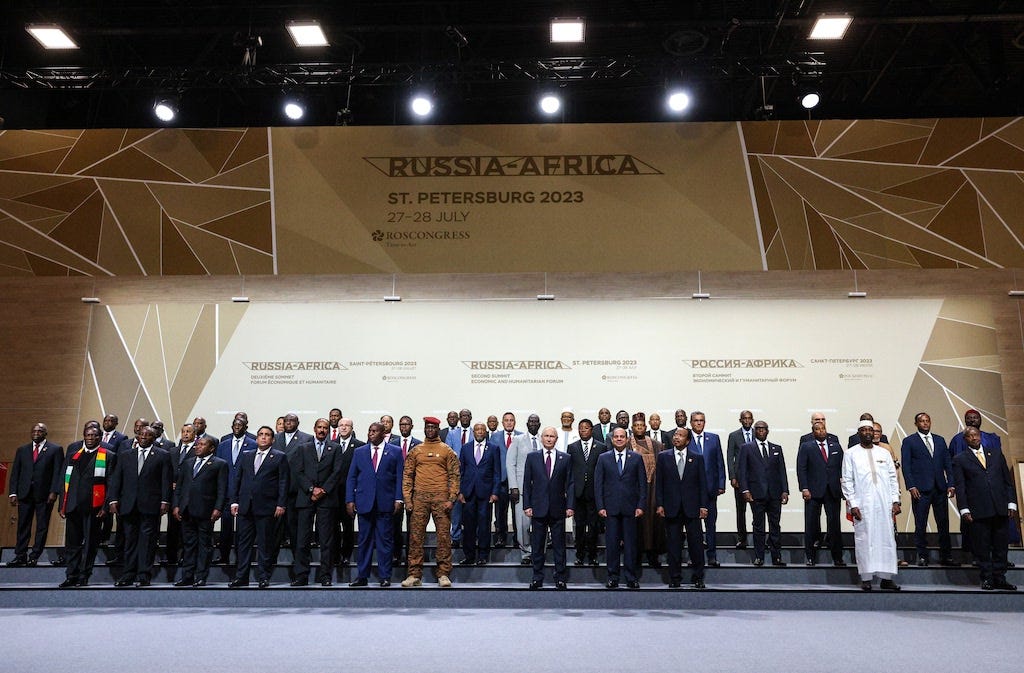
As Russia prepares to host the third Russia–Africa Summit in Moscow on October 28–29, 2026, seventeen African leaders have confirmed their attendance. Following previous summits in Sochi in 2019 and St. Petersburg in 2023, the meeting offers an opportunity to examine how Moscow seeks to strengthen its political and economic ties with mineral-rich African countries.
The Deputy Minister of Foreign Affairs of the Russian Federation, Georgy Borisenko, outlined the key topics on the Summit agenda, including trade, economic cooperation, investment, cooperation in the peaceful use of nuclear energy, the development of payment systems, digitalisation, and food security.
The Russia–Africa Economic and Humanitarian Forum, operated by the Roscongress Foundation, will be held as part of the Summit. Deputy CEO of the Roscongress Foundation Alexandra Ogneva noted that the Forum will again serve as a key platform for developing practical solutions aimed at strengthening the multifaceted partnership between the Russian Federation and African countries.
Beyond its economic and diplomatic agenda, the summit also provides a platform for Russia to shape African perceptions. The strategic narrative of the summit aligns with the concept of narrative construction, through which Russia and Ukraine sought to shape African perceptions of the war and gain international support. Russia aimed to secure African votes to prevent diplomatic condemnation and legitimise its recent aggression, while Ukraine intended to seek to gain African support for condemning Russia’s actions against its territory.
To achieve these goals, officials from both Russia and Ukraine undertook several diplomatic visits to Africa, particularly between 2022 and 2025. As Russia– Ukraine compete in diplomatic warfare in Africa. Russia positions itself as an anti-imperialist by portraying itself as a non-conditional partner of Africa and a guarantor of food, energy, and security for African countries, and this summit will play an integral role in reinforcing Moscow’s diplomatic influence across the continent by consolidating political partnerships and countering Ukraine’s diplomatic outreach.
By highlighting the imperialist nature of the West and noting that many African nations harbour scepticism toward Western powers due to their colonial histories, Russia aims to shape the moral narrative of the war in Africa.
In fragile, conflict-prone states like Mali, Burkina Faso, Niger, and the Central African Republic, Russia builds its influence prominently. Russia deploys state-backed military contractors (formerly the Wagner Group, now rebranded as the state-controlled Africa Corps) and supplies arms to shore up military juntas and besieged regimes. According to Business Insider Africa (2025), Russia has secured $4 billion in military contracts with 46 African countries, including arms exports, military training programmes, technology transfers, and shared defence technology. Russia’s largest arms customer on the continent, Algerian Head of State Abdelmadjid Tebboune, is yet to respond to attend the summit.
According to Ignacio Fuente Cobo, “The Russian Obsession: Disinformation and Propaganda in the Sahel,” Since 2022, at least 80 Russian-sponsored campaigns have been identified, targeting more than 22 African countries, reaching millions of people through fake or dubious websites, publications and media channels. Russian disinformation in the Sahel is aimed at strengthening its position, replacing Western powers, especially France, as the main partner in the resource-rich and strategically vital Sahel region.
Russia has built a narrative around anti-colonial sentiment and historical grievances associated with European colonial rule to shape African public opinion against France and other Western powers. After the withdrawal of French troops from Chad in 2024, pro-Russian accounts circulated videos portraying the military withdrawal as a symbolic end to French colonial influence.
The investigation by the FRANCE 24 Observers team, in collaboration with an international consortium coordinated by Forbidden Stories, revealed a substantial Russian influence operation targeting West African media outlets. The investigation, based on about 1,400 leaked internal documents, identified a network of Russian operatives known as Africa Politology, which coordinated the placement of pro-Russian and anti-Western content in African news outlets.
According to Radio France Internationale, Africa Politology, which is also known as “the Company,” was a Wagner-linked network associated with Yevgeny Prigozhin. Soon after his death in August 2023, investigators reported that it came under the operational and financial control of Russia’s Sluzhba Vneshney Razvedki (Foreign Intelligence Service) by late 2023.
The United States and the European Union are investing in regional trade and critical-mineral supply chains in the Lobito Corridor. It connects the mineral-rich regions of the Democratic Republic of Congo and Zambia to Angola’s Atlantic port of Lobito. The Russian network portrayed Western involvement as exploitative, neo-colonial, or akin to a “mafia” operation. Through these narratives, the campaign attempted to undermine trust in Western initiatives and position Russia as an alternative partner for African countries.
As reported by Wawlaw Press, the number of African students enrolled at Russian universities has reached a record 37,000. This highlights the expanding cooperation with African countries through cultural diplomacy, the Orthodox Church, and higher education. These networks can produce future officials, journalists, academics, and business figures aligning with Russian narratives.
At the 2023 Russia–Africa Summit in St. Petersburg, Moscow pledged to provide Burkina Faso, Zimbabwe, Mali, Somalia, the Central African Republic, and Eritrea with between 25,000 and 50,000 metric tons of grain each, amounting to a total commitment of 200,000 metric tons. However, the implementation of this pledge remained limited. The 2023 Russia–Africa Summit in St. Petersburg concluded with the signing of 161 agreements that were not classified as commercial secrets. This included 146 agreements with foreign organisations and authorities, most focused on humanitarian cooperation.
Russia has agreements for military cooperation with more than 40 African countries, which are largely centred in Mali, Niger, the Central African Republic, and the wider Sahel region. Greater emphasis is needed on long-term industrial cooperation and sustainable security partnerships that deliver benefits to African states.
Russia’s African strategy will involve developing ideological narratives and expanding military, as power competition has been a key approach to gaining geopolitical advantage in the region. Russia’s expanding presence in Africa may face growing competition not only from Western powers but also from China.
It seems that aside from diplomatic summits and propaganda campaigns, Russia’s economic, humanitarian and military influence in Africa remains limited. Russia’s relations with African countries aren’t tarnished by colonial expansion, and Russia could have a big potential for projecting its soft power in Africa.