


(Author is former professor, School of International Studies, Jawaharlal Nehru University, New Delhi)
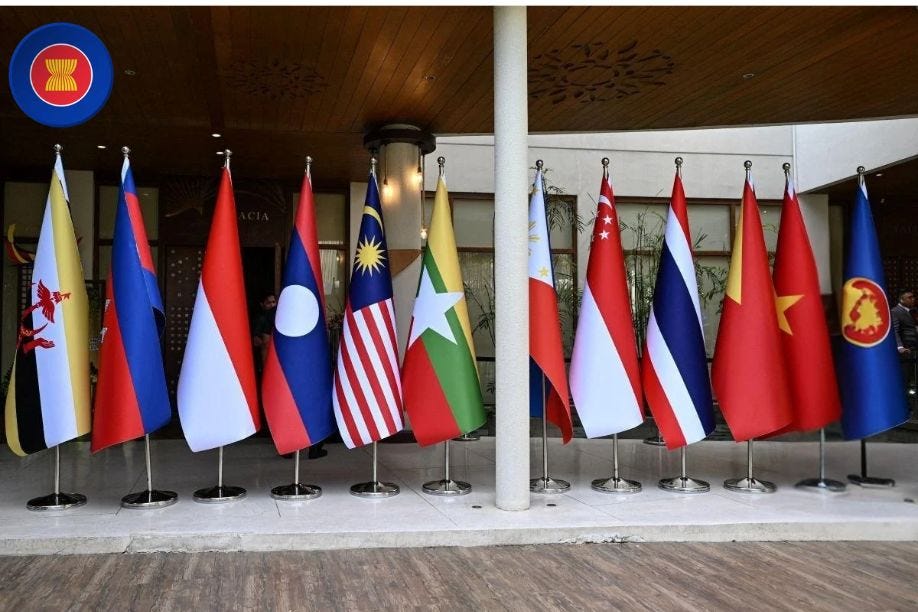
Starting tomorrow over ten thousand delegates and visitors are arriving in Manila which is hosting in next three days at least nine ASEAN-centred summits plus the much delayed Quad summit which not happening in India which is the current chair of Quad but in the Philippines which is not even a member of Quad. Collectively, November 15-17 will see world leaders rubbing shoulders at these diplomatic gatherings that include the 49th ASEAN summit, 29th ASEAN Plus-Three Summit, 21st East Asia Summit, 8th Quad Summit plus the six bilateral ASEAN summits with Australia, China, India, Japan, New Zealand, South Korea and the United States. To the least these are expected to enact one of most intense as also rather hectic pace of deliberations with longer term impact for Asian geopolitics.
Lately, with world having been far too focused on destructive wars in Ukraine and the Middle East, these leaders of world’s most powerful and competing nations arriving in Manila has already moved media search lights back to the Asia-Pacific. Moreover, the tone set in Manila in next three days is also significant as it will also set the mood for the likely outcomes from their subsequent APEC Summit taking place in China’s Shenzhen city during November 18-19, 2026. The APEC summit is also anticipating not just the third-of-this-year Trump-Xi bilateral summit but also a likely triangular Trump-Xi-Putin summit. President Xi, who had separately hosted Trump and Putin in Beijing earlier this year, will now be hosting this trilateral in Shenzhen.
So the question at Manila will not just be who and how many will be joining these summit deliberations but whether Manila will have the levers to orchestrate their agenda as also outcomes? Especially the Quad summits, which has been delayed for over two years since September 2024, these summits can well become Manila’s moment bring focus back to the Asia-Pacific region and to reassert how the ASEAN remains at the centre-stage in the shaping of Asia’s future.
Three days, ten summits
Starting Sunday, Manila will be at the center stage for next three days. Few gatherings can offer parallel to such a concentrated diplomatic spectacle on regionalism, strategic rivalry and great-power engagement all at once. World leaders, diplomatic brass, businesses, media and all other stakeholders will converge in the Philippines capital that is also completing its year as ASEAN chair under the theme ‘Navigating Our Future, Together’ which alludes to much celebrated ASEAN camaraderie still remains but work in progress.
This ASEAN choreography will be put to test once again as ASEAN’s eleven members engage with China, Japan and South Korea through ASEAN+3; Washington through its Special Summit; Beijing through the ASEAN-China Dialogue; and with a constellation of powers, including Australia, India, Japan, New Zealand and Russia. To gauge current diplomatic tempers, on 30th October, at the Atlanta G20 Foreign Ministers’ meet had to cancel their usual ‘family photo’ in wake of Australia among others objecting to being photographed with Sergei Lavrov. These two nations will again be coming face to face at the APEC summit in Shenzhen while Quad summits at Manila may have to deal with questions on its lingering debate about Quad Plus co-opting other nations.
Second, their differences are not only limited to their style but also define their substance. These ten summits, for instance, do not believe in a single shared vision of Asia’s future. They represent distinct templates on what to prioritise and even how Asia should organise itself. ASEAN’s own summit embodies Southeast Asian cohesion; ASEAN+3 reflects the evolution of East Asian economic interdependence; the East Asia Summit offers an inclusive strategic conversation; and the Quad represents a more focused minilateral approach to Indo-Pacific geopolitics. The ASEAN-US and ASEAN-China summits, meanwhile, will also reinforce the continued central challenge confronting this region: engaging both these competing superpowers without surrendering diplomatic autonomy.
Third, the personalities of iconic leaders promises to add another layer of intrigue. Donald Trump is scheduled to attend the ASEAN-US Special Summit on 17 November before travelling to Shenzhen for the APEC summit, where his meeting with Xi Jinping (and possibly trilateral with Xi and Putin) is anticipated. The focus of Trump travel to Manila has been shifting from seeking early end to wars in Ukraine and Iran to reviving nuclear arms control talks with Moscow. His interactions in Manila, therefore, will be seen to gauge his possible diplomatic overture to the next major encounters at Shenzhen. Experts are now comparing this trilateral to the historic 1945 Yalta Conference of the leaders of US, Britain and the Soviet Union that shaped post-World War II order.
The real significance of summits in Manila, therefore, lies not in the numbers or the tenor of leaders’ photographs but in whether ASEAN will be able to convert this extraordinary diplomatic congregation to reassert its centrality and regional influence. Or will it se great powers once again dictating their terms to Asia’s nations.
Centrality under siege
Indeed, the creation of Quad had already cast a shadow on ASEAN centrality in the Asia-Pacific region. ASEAN on the driving seat had long been the organising principle of Asia-Pacific regionalism. Rather than constructing an exclusive security bloc, ASEAN was built as an architecture that allowed competing powers to participate in its shared forums. Its genius lay in making Southeast Asia indispensable to conversations about the wider Asian order. The United States, China, India, Japan, Russia and Australia could all engage through institutions in which ASEAN retained the convening role. Especially, since the early 1990s, this had seen ASEAN launching new platforms from ASEAN Regional Forum to East Asia Summit and initiating bilateral summits with other major powers of Asia-Pacific region.
But in presence of Quad what has become increasingly visible in case of ASEAN is that convening is not the same as commanding. ASEAN’s consensus-based decision-making, while protecting the interests of smaller states, has also resulted in dilution of its ability to respond decisively to strategic exigencies. Its internal differences over China, maritime disputes and relations with Washington were seen frequently constraining its collective action. The South China Sea is the most visible manifestation of this dilemma. The Philippines has made concerted progress towards a Code of Conduct with China, but negotiations have failed to meet the ambition of concluding an agreement in 2026.
The Quad presents another acid test. Its members repeatedly endorse ASEAN centrality, but its selective membership and strategic orientation inevitably raise questions about whether minilateral cooperation complements or circumvents ASEAN-led institutions. The distinction matters. The Quad has moved faster on maritime surveillance, on critical technologies and supply-chain resilience, while ASEAN provides broader regional legitimacy. Of course the two need not be necessarily competitors. Indeed, there is a possibility of crafting their distinct roles where Quad can pilot practical initiatives that must subsequently acquire wider acceptance through ASEAN mechanisms.
Myanmar, meanwhile, remains ASEAN’s most uncomfortable internal contradiction. Its military leadership continues to be excluded from representation at the highest political level, with a senior Foreign Ministry official representing the country instead. Yet its prolonged exclusion exposes the limits of ASEAN’s Five-Point Consensus and its difficulty in translating diplomatic pressure into political change. Likewise for India, which shares a long border with Myanmar and has substantial security, connectivity and economic interests there, the continuing crisis is more than an ASEAN institutional problem. It affects India’s Act East ambitions, border stability and regional connectivity, while reinforcing the importance of sustained engagement with relevant stakeholders.
Who Shapes Asia?
The most consequential question emerging from Manila is whether Asia’s overlapping regional institutions can coexist productively or are they increasingly becoming the instruments of competing geopolitical alignments of superpowers. ASEAN+3, the East Asia Summit and the Quad are not necessarily contradictory but they do pull in different directions as they seek to address different dimensions of regional cooperation. But it is also true that their effectiveness will depend on whether they can reinforce a broadly shared Asian order or undercut each other with their deepened strategic fragmentation.
India occupies an interesting position in this architecture. It is a participant in the East Asia Summit and a founding member of the Quad. Indeed, India sees genesis of Quad located very much in East Asia summits. Its commitment to ASEAN centrality and their shared Indo-Pacific vision offer opportunities to bridge different regional platforms. New Delhi has consistently resisted the idea that the Indo-Pacific should become an exclusive geopolitical bloc directed against China. Its strategic autonomy is therefore not simply a diplomatic preference; it is also an instrument for preserving room for manoeuvre in an increasingly contested Asian order. For India, Manila will be an opportunity to strengthen its engagement with ASEAN while demonstrating that the Quad can contribute to regional public goods without becoming an Asian NATO.
India is therefore expected to make its contributions to ensuring that outcomes from Manila can further strengthen building of Asia’s maritime security, digital connectivity, resilient supply chains, disaster management and infrastructure cooperation. These three days deliberations at Manila will be measured not by their exhaustive declarations but by whether they can produce a more capable and cohesive regional architecture. ASEAN cannot prevent great-power rivalry, nor can it expect its unanimity on every strategic question. But it must surely preserve its institutional space in which stakeholders in Asian stability continue to talk, negotiate and cooperate. Manila’s ten summits in three days may not remake the Asian order. These can, however, determine whether ASEAN remains its indispensable convenor — or whether gradually it becomes the backdrop to decisions made elsewhere.
Prof. Dr. Swaran Singh is a member of The Frontier Review’s Editorial Advisory Board.
To learn more about the author, please visit our Editorial Advisory Board page.