


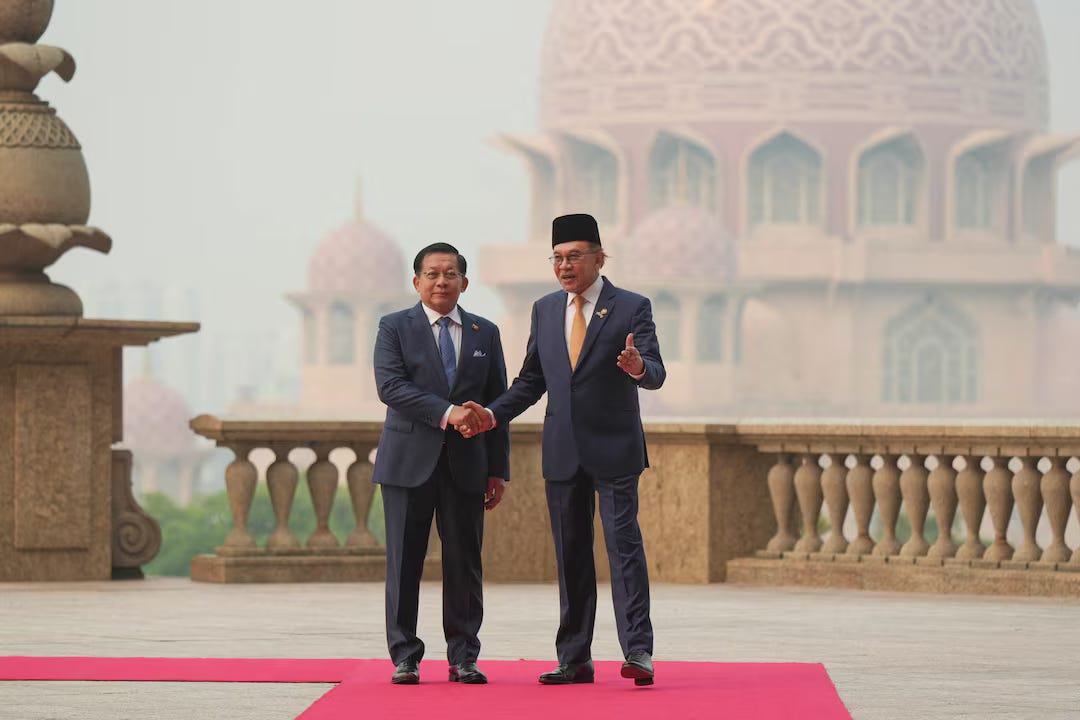
Myanmar’s President Min Aung Hlaing walks with Malaysia’s Prime Minister Anwar Ibrahim. Azneal Ishak/Pool via Reuters.
Malaysia recently became the fifth ASEAN member state to host Myanmar’s military leader-turned-President Min Aung Hlaing since he took office in April, following his visits to Thailand, Cambodia, Vietnam and Laos. This diplomatic outreach effort, with growing engagement between Myanmar and some governments, rightfully signalled that the country will eventually rejoin the Southeast Asian bloc, ASEAN.
Prime Minister Anwar Ibrahim’s political secretary Kamil Abdul Munim has defended Putrajaya’s engagement with Myanmar junta chief Min Aung Hlaing, saying talks should not be mistaken for recognition or endorsement of his regime.
Prime Minister Anwar Ibrahim has put forward its commitment to engage with Myanmar on several issues, including the return of thousands of Myanmar nationals currently in Malaysia. Anwar confirmed that 10,493 Myanmar nationals had been repatriated so far this year, and he has also vowed to push for Myanmar to accept Rohingya refugees.
“We are concerned by these returns at a time when people sent back to Myanmar may face serious risks, and some within the group may be in need of international protection,” said UNHCR Assistant High Commissioner for Protection Edem Wosornu. The repatriation initiative has drawn criticism from the United Nations and human rights organisations, which warn that returning people amid Myanmar’s ongoing civil war could expose them to serious risks.
According to the Associated Press, Malaysia hosts approximately 215,600 refugees and asylum-seekers registered with the UN refugee agency (UNHCR), including around 126,000 Rohingya, making them one of Southeast Asia’s largest refugee communities. However, Malaysia has not signed the 1951 UN Refugee Convention and classifies refugees as undocumented migrants, leaving them without formal legal recognition under its domestic framework.
During the summit, Malaysia and Myanmar discussed returning Myanmar asylum-seekers from Malaysia and exploring investment opportunities in Myanmar despite its ongoing conflict. The meeting marked another step in Min Aung Hlaing’s efforts to rebuild his international standing. Five years earlier, he led the military coup that plunged Myanmar into a devastating civil war and isolated the country from much of the international community.
After the military regime took control in Myanmar in 2021, ASEAN’s Five-Point Consensus (5PC) was adopted to end violence, facilitate dialogue and deliver humanitarian assistance, but ASEAN could not bring the military authorities, pro-democracy resistance and ethnic armed organisations into a sustained peace process. Now, continued expansion of diplomatic engagement, without corresponding progress on the ground, is undermining the credibility of the bloc's own commitments.
Min Aung Hlaing has been implicated in many abuses, and the International Criminal Court prosecutor has requested an arrest warrant for his alleged crimes against humanity. This includes the 2016–2017 campaign of mass killings and forced displacement that drove hundreds of thousands of Rohingya Muslims from the country.
Washington has formally recognised the military’s actions against the Rohingya as genocide. US Assistant Secretary of State for Intelligence and Research Michael Vance visited Myanmar on 15–16 September 2026, meeting Min Aung Hlaing in Naypyitaw. The visit was aimed at securing the release of detained American businessman Adam Castillo. He was released after spending three months in detention in Myanmar. This incident reflects how Min Aung Hlaing showcased hostage diplomacy.
Reuters reported on 16th October 2026 that Washington had held a second round of talks with Myanmar’s military-backed government in Tokyo. Discussions reportedly included scam centres targeting Americans and potential access to Myanmar’s rare-earth deposits. This provides a useful example of how security and economic interests can encourage governments to engage with an otherwise diplomatically isolated leadership.
UN Human Rights Chief Volker Türk condemned the military airstrikes in Myanmar’s northwestern Rakhine State that reportedly killed at least 50 civilians on 28 September 2026. This included women and children at a busy market in Kyauktaw township. The strikes also injured at least 58 people. The military hit a crowded market which had people from diverse communities, including Rakhine, Rohingya, Hindu and Daingnet groups, exposing the gap between regional diplomatic engagement and continued violence against civilians.
Aung San Suu Kyi, Myanmar’s former civilian leader, has remained in detention since the February 2021 coup. Her freedom could mark a significant diplomatic victory for ASEAN to present the crisis as moving towards resolution while resuming economic and political engagement with Myanmar.
More than five years after the coup, a new generation of activists has reshaped Myanmar’s political landscape. Armed resistance now drives the struggle against military rule, while ethnic resistance organisations wield greater influence. The NLD (National League for Democracy, Myanmar’s pro-democracy political party led by Aung San Suu Kyi) has also lost its organisational dominance over the democratic movement. Meanwhile, authorities have kept Aung San Suu Kyi in detention, leaving her no opportunity to influence these developments.
A red-carpet reception may confer diplomatic normality, but it cannot manufacture domestic legitimacy for a regime that came to power through a coup and continues to wage war against its own population. Anwar Ibrahim’s journey from political prisoner to prime minister gives his engagement with Min Aung Hlaing a sharp irony, bringing a host who once endured detention, with the guest now presiding over a state that jails its democratic leadership.