


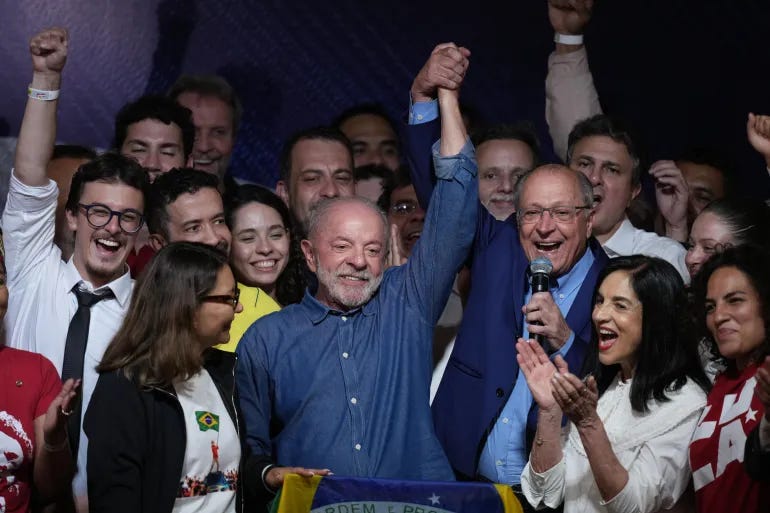
President Luiz Inácio Lula da Silva celebrates with his running mate Geraldo Alckmin after winning a fourth term in the presidential run-off in Brazil. [Andre Penner/AP Photo]
As the incumbent left-wing leader, Luiz Inácio Lula da Silva turns 81 on October 27; joyful cheers of “Let’s go, Lula! soared in São Paulo after the declaration of Brazil’s 2026 presidential election result. Lula made history by securing victory over Flávio Bolsonaro. Brazil’s Superior Electoral Court showed that Lula secured 51.8% of the valid votes and Bolsonaro gained 48.2%. He emerged as the first Brazilian president to win four presidential elections, having previously won in 2002, 2006 and 2022.
The opposition candidate Flávio Bolsonaro is the son of former President Jair Bolsonaro. Lula defeated Jair Bolsonaro in the 2022 election and made him serve a 27-year prison sentence after his conviction for attempting a coup.
In the first round of the election, Lula initially got a setback; then he achieved a commendable comeback over the following three weeks. He added more than 10 million votes compared with his rival’s 3.6 million. The votes casted in Minas Gerais, Brazil’s second-most populous electoral state, proved favourable to Lula. Lula overcame an initial deficit of nearly 590,000 votes to secure a lead of approximately 99,000. This swing was around 690,000 votes, which changed the course.
More than 33 million Brazilians did not vote in the first round, an abstention rate of 21.08 %, the highest for a presidential election first round since 1998. Millions more cast blank or invalid ballots. The scale of abstention points to a broader problem of political alienation.
Lula’s Political Ideology and Path to Power
Lula’s left-wing politics are rooted in his early years as a factory worker and trade union leader. He began his political journey by leading strikes and protests against working conditions during Brazil’s military dictatorship. In the 1980s, he helped mobilise thousands of trade unionists to establish the Workers’ Party (Partido dos Trabalhadores, or PT), which became a major force on Brazil’s political left.
Lula’s first three presidential bids, in 1989, 1994 and 1998, ended in defeat. At this point, Brazil’s inflation was so out of control and about a fifth of the country was in poverty. By 2002, Lula forwarded a collective strategy to win the election. He brought centre-right parties and business leaders, including José Alencar, into his new coalition. This helped him attract support beyond the traditional left and win his first presidential election.
After his political victory, Brazil’s economy grew rapidly, mostly because of a booming trade partnership and investment with China. He used this cash flow to finance a new social welfare and cash transfer program: Bolsa Família, which gave Brazilians a stipend for ensuring their children were attending school and up to date on their vaccines. This ensured people’s immediate needs, child welfare and planning for overall development. His government also raised the minimum wage to support Brazil’s poorer voters.
Despite corruption allegations surrounding his administration, Lula won a second term in 2006, buoyed by his popularity. By the end of his presidency in 2010, Brazil’s economy had reached record levels and his approval rating remained high. In 2009, Lula selected a fellow Workers’ Party member, Dilma Rousseff, as his successor. She inherited his coalition and easily won the presidency in 2010.
As her term began, global demand for commodities fell, which led to a recession in Brazil. Her economic advisory team was not good at managing the crisis, and her awful negotiations with Congress led to more problems in the early days.
In 2014, an investigation involving federal prosecutors, the Federal Police and the judiciary reported rampant corruption connected to Brazil’s state-controlled oil company, Petrobras. Investigators said that major construction firms paid bribes to Petrobras officials to win large contracts. Some of the money was also allegedly passed to politicians and political parties in Brazil’s ruling coalition. The scandal tarnished the Workers’ Party’s credibility. In 2016, Dilma Rousseff was removed from office after Brazil’s Senate found her guilty of breaking budget laws. Her government had delayed payments to state banks and issued spending without congressional approval. She was not convicted in the Petrobras corruption scandal.
Lula was later convicted of corruption and money laundering in July 2017. Even though he denied all allegations, he was still imprisoned in April 2018 and released in November 2019 after serving 580 days. In 2019, Brazil’s Supreme Court released Lula from prison, and the Supreme Court annulled his convictions in 2021, restoring his political rights and clearing the way for his 2022 candidacy. In the 2022 election, Lula presented himself as a defender of democracy and built a broad coalition that crossed ideological lines. It included eight former presidential candidates, politicians from both the left and the right, and much of the business community. He also reached out to evangelical voters by campaigning at churches.
Bolsonaro, meanwhile, introduced social programmes to attract low-income and working-class voters, many of whom traditionally supported Lula. But as election day approached, Lula’s strategy appeared to be gaining ground, with polls closely reflecting his electoral support, winning 50.9% of the votes
The close run-off led Bolsonaro to question electronic voting and claimed that the election had been rigged. Then a week after Lula’s oath-taking, thousands of Bolsonaro supporters marched to the National Congress, Supreme Court and presidential palace in Brasília. This caused chaos, damaging public buildings. The attack symbolised the U.S. Capitol riot of January 6, 2021 and marked the most serious challenge to Brazilian democracy since military rule ended in 1985.
Brazil’s Supreme Court convicted Jair Bolsonaro of attempting to abolish democratic order by force, organising a coup, membership of an armed criminal group, and damage to public property. He was sentenced to 27 years and three months in prison and barred from office until 2060. Flávio Bolsonaro, his eldest son and a Liberal Party senator, positioned himself as the movement’s political heir and promised to free his father if he gets elected in the 2026 election, but Lula ultimately won the 25 October runoff. What started as welfare politics later developed into a family-led electoral movement.
Lula’s Foreign Policy and Brazil’s Global Ambitions
Brazil is the largest country and economy in Latin America. Lula’s victory dealt a setback to President Donald Trump’s ambition to build a region aligned with his political ideology. Lula’s fourth term represents continuity in Brazil’s effort to position itself as a leader of the Global South, but it arrives amid a stronger right-wing Congress and renewed U.S. pressure.
Lula’s presidency in 2023 played an integral role in presenting Brazil as a global player. Between 2024 and 2025, Brazil hosted several high-level diplomatic meetings from the BRICS, G20 and COP30 summits. The negotiations of the EU–Mercosur trade agreement and deeper ties with non-Western partners, especially ASEAN countries, were revived. Lula has presented Brazil’s resistance to external pressure as a defence of sovereignty rather than anti-Americanism.
As a founding member of BRICS, Brazil present a different view on the Russian war against Ukraine in comparison to the European Union. Brazil depends on Russian fertilisers and, constitutionally, cannot apply sanctions outside of the UN Security Council’s provision. Lula’s continuity also brings closer coordination in IBSA(India–Brazil–South Africa). This is particularly relevant to UNSC reform, where India and Brazil have long supported one another’s aspirations for permanent membership. Lula’s election agenda and broader vision depict that his foreign policy priorities include increasing defence spending and widening exchanges with Asia, Africa, the Middle East and Europe.
On climate, Lula’s efforts to bring COP30 to Brazil. Lula’s strategy can be characterised as one of “state-guided diversification.” On the diplomatic front, Lula leans into his traditional posture of reinforcing Mercosur, advancing South American integration, and expanding South-South cooperation and balancing China, a key pillar of Brazil’s foreign policy under Lula. His reelection preserves this foreign policy orientation, but a right-wing Congress and U.S. economic pressure mean that Brazil’s global ambitions will depend as much on domestic coalition management as on diplomatic skill.
Bolsonaro’s Liberal Party might bring domestic constraint in the long run. It is already compounded by economic pressure from the United States, where tariffs on Brazilian exports have reached 37.5%, threatening competitiveness and giving Washington leverage in trade negotiations. Apparently, sustaining Brazil’s role as a bridge between the Global South and the wider international system is a larger objective Lula should focus on.