


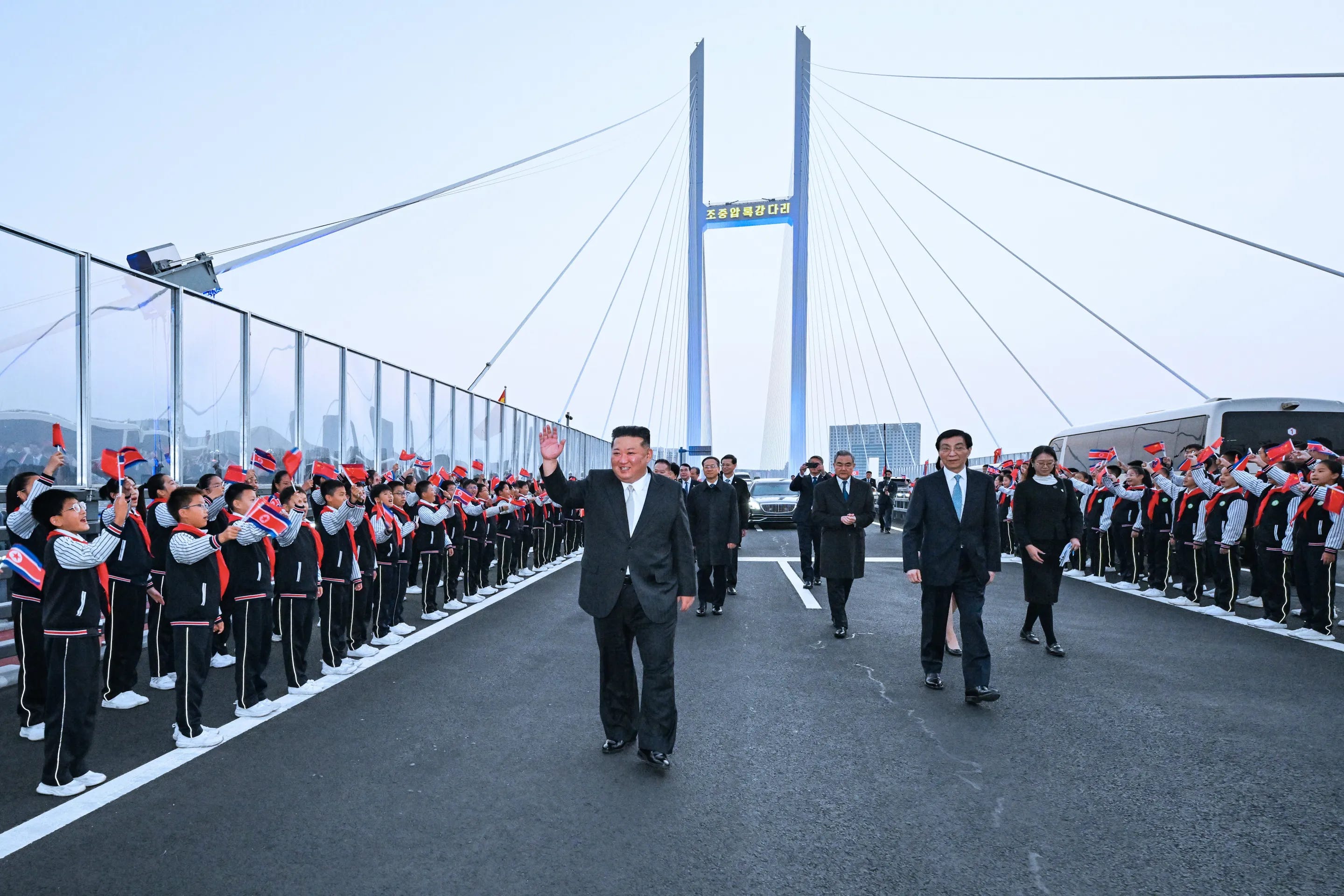
Photo released by Xinhua News Agency. Kim Jong Un crossing the new bridge at the Yalu River.
Kim Jong Un’s surprise visit to the Chinese border city of Dandong on October 24 was more than a ceremonial trip to a Korean War memorial. By crossing the New Yalu River Bridge, officially known as the Korea-China Amnok River Bridge, by road, he sent a symbolic message of renewed engagement between Pyongyang and Beijing. He was accompanied by Wang Huning, China’s fourth-highest-ranking official.
The 3,026-metre four-lane bridge connects Dandong in northeastern China with Sinuiju in North Korea. It was completed by China in 2014 at a cost of US$350 million, but was delayed for 12 years before becoming functional. The bridge’s opening was delayed by financial disagreements over North Korea’s customs facilities and connecting roads, followed by nuclear-related tensions, UN sanctions and Pyongyang’s pandemic-era border closure.
The opening marks a gradual return to normal relations. Truck trade resumed in 2023, and the Beijing–Pyongyang passenger train restarted in March 2026 after six years. The new highway bridge will also support heavy cargo transport. The New Yalu River Bridge is an alternative to the decades-old Sino-Korean Friendship Bridge, which was built between 1937 and 1943 during Imperial Japan’s occupation of the region.
The bridge will help North Korea to import heavy machinery, raw materials and energy supplies needed for its economic development. For China, it will improve access to the North Korean market and support cross-border trade. Its opening could also encourage greater commercial exchanges and economic cooperation between the two neighbours. As China remains North Korea’s largest trading partner, improved connectivity could further strengthen future regional partnership.
“The relations between China and North Korea have entered a new stage, embarking on a new chapter,” Chinese Premier Li Qiang said in a video address at the ceremony, according to China’s official Xinhua News Agency.
On October 24, Kim Jong Un also visited the Memorial Hall of the War to Resist U.S. Aggression and Aid Korea in Dandong, where he laid a flower basket in memory of Chinese soldiers who fought in the Korean War. He also viewed historical exhibits and presented the hall with a photograph bearing his personal inscription. Later, Kim visited a car factory, inspected its production workshop and received a briefing.
China and North Korea’s relationship is built on mutual assistance and shared strategic interests. During the Chinese Civil War, Pyongyang supported Chinese communists with supplies and manpower, while Chinese troops, known as the Chinese People's Volunteer Army (CPV), later reciprocated with military assistance during the Korean War. In October 1950, Chinese forces crossed the Yalu River to help North Korea push back United Nations Command advances. The conflict ended in an armistice in 1953.
The 1961 Treaty of Friendship, Cooperation and Mutual Assistance formalised ties between the two countries. During the early decades of the Cold War, Beijing considered Pyongyang a socialist partner. The two countries built their relationship around shared revolutionary goals and opposition to the United States. From the 1970s, Beijing gradually moved towards improving relations with the US, while its solidarity with North Korea became less central to its public narrative. In recent times, the Korean Peninsula has become important in China's security concerns.
North Korea’s nuclear programme became a major concern in the early 1990s. IAEA inspection of the Yongbyon nuclear complex in 1992 and US intelligence identified a suspected secret nuclear facility through satellite imagery. Amid international pressure, North Korea announced its intention to withdraw from the Nuclear Non-Proliferation Treaty (NPT) in 1993, triggering the first nuclear crisis on the Korean Peninsula.
China’s policy towards North Korea has been influenced by security interests and relations with the United States. Although Beijing initially stayed out of the 1994 nuclear crisis, it changed its course in 2003. China organised the Six-Party Talks and became host and chair, which began in Beijing in August 2003. The Six-Party Talks were a series of multilateral discussions held from 2003 to 2007, primarily aimed at addressing North Korea’s nuclear program. They were hosted in Beijing and chaired by China. The talks involved six states: China, Japan, North Korea, Russia, South Korea, and the United States.
It sought to prevent nuclear escalation while maintaining its relationship with Pyongyang. Beijing also used trade and aid as pressure after North Korean nuclear and missile tests. It supported UN sanctions in 2006 and backed stronger measures in 2017, but opposed further sanctions in 2022. This shift reflected worsening US–China relations. China therefore faces a dilemma: it wants a stable, non-nuclear Korean Peninsula, while also seeking to preserve North Korea as a key strategic partner and buffer.
Hong Min of South Korea’s Korea Institute for National Unification indicated that the visit aligned with the 65th anniversary of the 1961 friendship treaty. Korean press coverage also suggested the trip could set up a meeting between Kim and Trump, and other Asia-Pacific leaders, in the southern Chinese city of Shenzhen in mid-November. The diplomacy ahead of APEC places that alignment within wider US-China rivalry. China still promotes a non-nuclear peninsula and values its ties with South Korea. Recent warmth therefore signals tactical convergence, not unconditional alliance.