


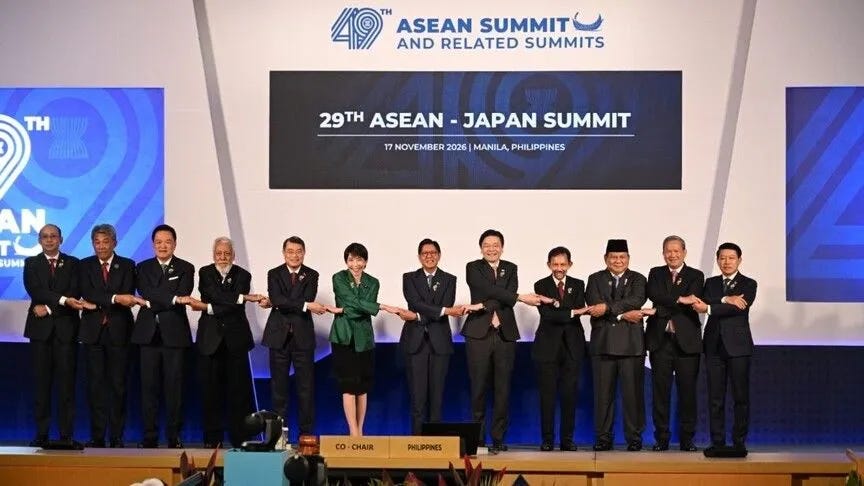
Takaichi Sanae, Prime Minister of Japan at the 2026 ASEAN-related summits in Manila proposed an updated Free and Open Indo-Pacific (FOIP), under which it will work hand in hand with regional countries to strengthen resilience, safeguard their freedom to choose their own future, and build a more resilient and prosperous Indo-Pacific together. She also mentioned that Japan will firmly play its role as a coordinator for Japan, China, and Korea so that ASEAN+3 can work closely together toward advancing and mainstreaming the ASEAN Outlook on the Indo-Pacific (AOIP).
Japan’s vision for a Free and Open Indo-Pacific (FOIP) has its roots in 2007, when Prime Minister Shinzo Abe introduced the concept of the “Confluence of the Two Seas” in an address to the Indian Parliament. The idea emphasised the strategic links between the Indian and Pacific Oceans.
In August 2016, Abe formally advanced this vision at the Sixth Tokyo International Conference on African Development (TICAD VI) in Kenya. He highlighted the potential of connecting two continents, Asia and Africa, with two oceans, the Pacific and Indian Oceans, to promote regional prosperity. In March 2023, Prime Minister Fumio Kishida announced a new FOIP plan in India. He called for greater international cooperation at a time of growing division and geopolitical confrontation.
The 2023 plan outlined peace and rules-based prosperity, regional cooperation, improved connectivity, and maritime and air security. It also seeks stronger partnerships and wider networks among like-minded countries. In October 2025, Prime Minister Takaichi pledged to further advance FOIP.
Evolved vision for a Free and Open Indo-Pacific (FOIP 3.0) included establishing secure subsea cable networks, Open RAN, and satellite systems under the "FOIP Digital Corridor" concept. Expansion of the Comprehensive and Progressive Agreement for Trans-Pacific Partnership (CPTPP) was also endorsed. Additionally, Partnership On Wide Energy and Resource Resilience Asia (POWERR Asia) to support regional emergency fuel procurement and energy infrastructure resilience was also forwarded.
To translate this diplomatic vision into greater regional security, the Japanese government has accelerated the revision of its three core security documents the National Security Strategy (NSS), the National Defence Strategy (NDS), and the Defence Buildup Program (DBP) bringing forward the update originally scheduled for 2027 to the end of 2026.
This documents the domestic defence capabilities, protecting critical industrial supply chains, and building resilient, multilayered regional security networks. To support this programme, Japan brought forward its target of allocating 2% of GDP to defence-related spending to FY2025. In FY2026, defence-related expenditure including costs related to the Special Action Committee on Okinawa (SACO) and the realignment of U.S. Forces Japan exceeded ¥9 trillion for the first time.
According to the Diplomatic Bluebook 2026, published by the Ministry of Foreign Affairs of Japan, Japan's security environment has become increasingly complex, with China, North Korea and Russia emerging as its principal state-level security concerns. China's expanding military capabilities, activities in the East China Sea and around the Senkaku Islands, and growing pressure over Taiwan remain major challenges. North Korea's nuclear weapons and ballistic missile programmes pose a direct threat to Japan.
These developments include Russia's aggression against Ukraine, the unstable situation in the Middle East, China's diplomatic posture and military activities around Japan, and the advancement of military cooperation between Russia and North Korea. Emerging threats such as cyberattacks and information manipulation, the spread of disinformation, and economic security issues need to be addressed by the international community. These developments have prompted Tokyo to strengthen its defence capabilities, intelligence infrastructure and security partnerships.
Four key operational capabilities of the updated defence strategy are the mass deployment of various drone systems to adapt to new warfare dynamics, acquisition of long-range precision strike assets, including upgraded Type-12 surface-to-ship missiles and U.S. Tomahawk cruise missiles, and systems capable of intercepting combined drone and missile saturation attacks
Key measures include adapting the Self-Defense Forces to atarashii tatakaikata (new ways of warfare), expanding long-range precision-strike and air-defence systems, and improving cross-domain capabilities in space, cyber and the electromagnetic spectrum. Tokyo also aims to protect vulnerable Western Pacific sea lanes, strengthen keisen nōryoku iji (combat sustainment capabilities), expand ammunition stockpiles, improve military recruitment and boost domestic defence production and supply-chain resilience.
Japan’s Official Security Assistance (OSA) framework projects the supply of non-lethal defence equipment to partner countries. Japan has provided a C-UAS to Malaysia, coastal radar and UAVs to the Philippines, high-speed patrol boats to Indonesia, and UAVs/RHIBs to Sri Lanka.
Geopolitical competition in the Indo-Pacific ignited resource coercion. In 2026, Japan experienced severe industrial strain when Chinese rare-earth shipments specifically dysprosium, terbium, and yttrium were tightly restricted. This led to an 82% collapse in dysprosium imports during the first half of the year. Japanese companies struggled to produce magnets and semiconductor-equipment components on scheduled time.
Japan's new security policy is neither an exercise in militarism nor a passive reaction to external pressure, but a calculated dual-track strategy. Friendly military exercises and engagement with the United States can be seen as strategically filling the existing vacuums in the regional order.
Reciprocal Access Agreements (RAA) with Australia and the Philippines, alongside minilateral frameworks such as the Quad, the Squad, and U.S.-Japan-ROK trilateral cooperation, have positioned Japan as a primary nodal agency in the Indo-Pacific's networked security architecture.
Japan’s prime minister argues in an article published in The Economist that regional countries and Japan must become more resilient and prosperous together to realise the vision of a Free and Open Indo-Pacific (FOIP). She described this collective effort as the surest path towards building an Indo-Pacific that can serve as a foundation for international peace and prosperity.