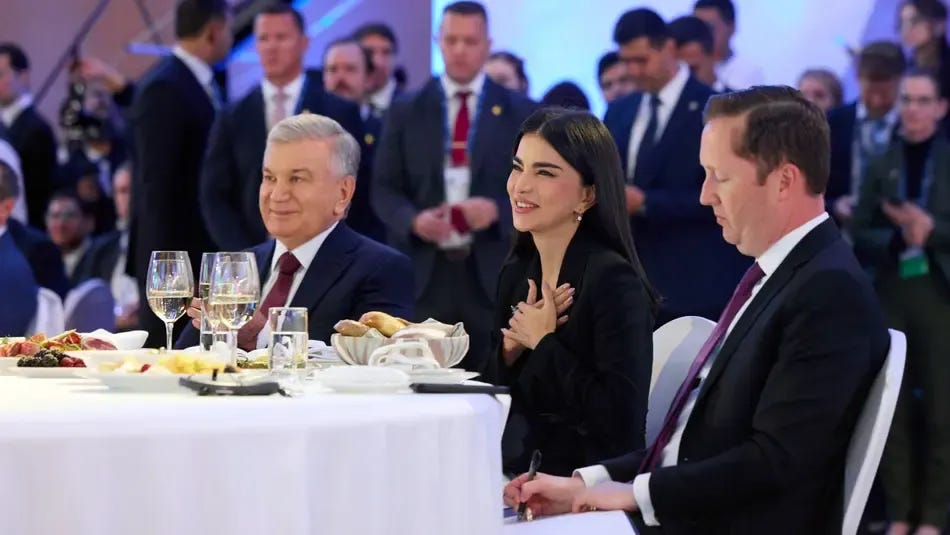
President of Uzbekistan Shavkat Mirziyoyev, Head of the Presidential Administration Saida Mirziyoyeva, and US Secretary of State Marco Rubio, Samarkand, October 2026 (Photo published on Saida Mirziyoyeva’s Telegram channel)
This August, Uzbekistan passed a constitutional law formalising the legal status and powers of the Presidential Administration, headed by Shavkat Mirziyoyev’s daughter, Saida Mirziyoyeva. The new law grants the Administration extensive authority to coordinate state bodies, oversee the work of hokims (local governors), implement judicial reforms, and exercise anti-corruption powers.
Under the new law, the head of the Administration – Saida Mirziyoyeva – automatically becomes deputy chairperson of the Security Council, which oversees the armed forces and matters of national security.
The body reports to and is subordinate only to the President, while all its members are granted lifetime immunity from criminal prosecution.
These extensive powers have fuelled speculation that Mirziyoyev is preparing his daughter to succeed him, potentially consolidating dynastic rule in Uzbekistan. But is this really the case? Are the rules of the game now set, or could the game itself still change?
In this episode of Turan Tales, journalist Agnieszka Pikulicka speaks with Rafael Sattarov, a Boston-based political analyst specialising in Central Asia and the broader post-Soviet space. His areas of expertise include Uzbekistan, regional geopolitics, authoritarian governance and political reform, as well as US policy towards Central Asia.
Originally published by Turan Tales, this episode is reproduced here through a collaboration with Agnieszka Pikulicka.
About: Agnieszka Pikulicka is a journalist and founder of Turan Tales, an independent long-form newsletter and podcast covering underreported stories of people, politics and social change in Central Asia. She previously served as Senior CEE Correspondent at Reuters and as Editor-at-Large and Co-editor at E-International Relations. She holds master’s degrees in International Relations from the University of Kent and the Higher School of Economics, where her academic work focused on Central Asia, Eurasian affairs and international security.