


By Lois Maskiell
(Author is a journalist and strategic communications professional with extensive experience across Australian newsrooms and diplomatic and defence organisations.)
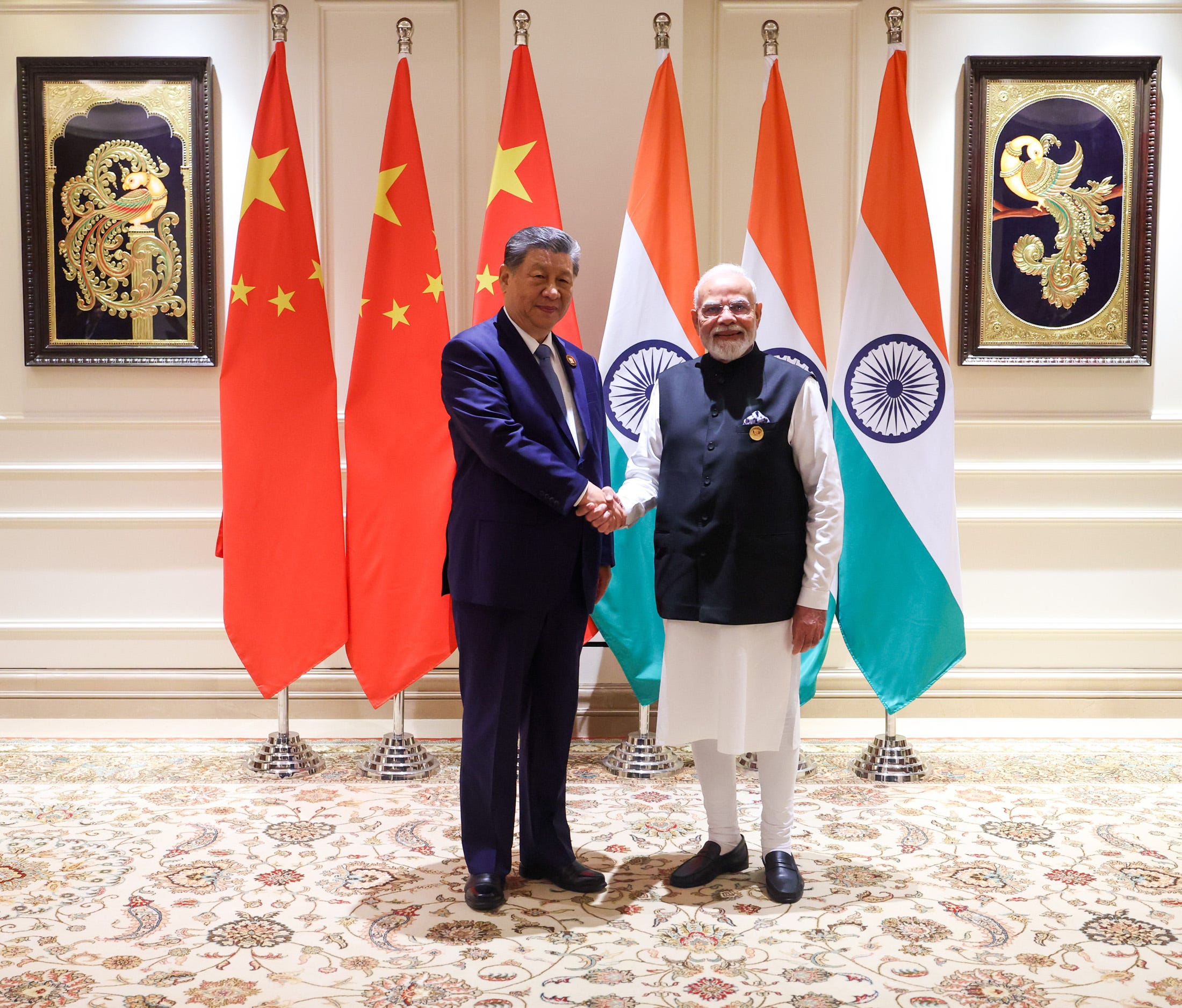
Indian Prime Minister Narendra Modi met Chinese President Xi Jinping at the 18th BRICS Summit in New Delhi in September, where both leaders expressed a desire to improve relations. Yet behind their statements of thawing diplomatic ties exists a dilemma. India is seeking to balance against China, while at the same time relying on it for the industrial inputs it needs to grow its own manufacturing base. India’s official statement about the meeting acknowledged the problem, with Prime Minister Modi saying the leaders had underlined the need to address “structural trade imbalance and supply chain issues”.
The meeting came six years after deadly clashes along their disputed Himalayan border in Galwan Valley. And while relations have since improved, border tension remains unresolved and the economic relationship remains imbalanced.
In the 2025-26 financial year, India imported US$131.63 billion worth of goods from China, while exporting only $19.47 billion in goods to China, Indian government figures show. China overtook the United States that year to become India’s largest trading partner. Even as Indian exports rose by 36.6 per cent and imports increased by 16 per cent, the gap remained substantial. The resulting $112.16 billion trade deficit, a record, illustrates the scale of the imbalance. It has not narrowed since: between January and September 2026, the deficit stood at about $105.9 billion.
Importantly, these imports are not always completed consumer goods. China supplies India with 30.8 per cent of India’s industrial imports, according to a 2024 report by the Global Trade Research Initiative. Electronics, machinery, computers and chemicals are among the key Chinese inputs supporting India’s manufacturing sector. A disruption to these supply chains would affect India’s ability to produce goods at home.
‘Rising powers care about status’
This dependence poses a challenge for India, a country with long-held aspirations to become a great power. In his book Ascending Power: Rising Powers and the Politics of Status in International Institutions, Dr Rohan Mukherjee explains why a state’s aspirations for international recognition and status drive it to make specific choices in global politics. He uses India’s response to the Cold War as one of several examples. “Rising powers care about status, or their position in a hierarchy, and are willing to pay significant costs for status relative to the great powers,” Dr Mukherjee states. He cites Jawaharlal Nehru, India’s first prime minister and foreign minister, who served from 1947 until his death in 1964. Nehru described India as “potentially a great power” that would one day be “the pivot” around which questions of Asian security would be considered. Nehru argued that it was “absurd for India to be treated like any small power in this connection”.
This pursuit of status by India is one of two key reasons that India must strengthen its economy. If it wants to translate its global ambition into influence, it should strengthen its manufacturing base. Unlike China, India developed a substantial services sector without first building a strong manufacturing base. So, as New Delhi seeks to expand domestic production, it faces a hurdle. A large portion of the components it needs to build that capacity are sourced from a strategic rival.
Trade vulnerabilities
Electronics are a clear example. A 2026 study by Koan Advisory found that China supplied at least 80 per cent of India’s imports in each of 71 electrical and electronics product lines in 2025-26, including components like motors, cables and switching equipment. The report also noted India’s dependence on China for routers and network switches, which are “at the core of telecom infrastructure”. “The pronounced trade deficits in these crucial industrial sectors emphasise India’s heavy reliance on strategically important imports from China, highlighting vulnerabilities in the trade structure,” the report states.
India is not ignoring the problem. A second reason that it should expand its manufacturing industry relates to its stated foreign policy approach of strategic autonomy. In this approach, the Indian government seeks to preserve its freedom to manoeuvre between major powers. Yet this strategy is undermined by India’s reliance on Chinese imports. Efforts to reduce this reliance are evident in various recent strategic partnerships and trade deals. For example, in the Quad, a diplomatic partnership between India, Australia, Japan and the United States, India is pursuing cooperation on critical minerals and resilient supply chains. India has also launched its National Critical Mineral Mission to strengthen domestic mineral production and secure overseas supplies.
India is also progressing new trading agreements. Negotiations for the EU-India free trade agreement concluded in January 2026, and the European Commission has since sent the text to the EU Council for approval, with both sides targeting a signing in December. The deal will still need the European Parliament’s consent before it takes effect. Talks for a trade agreement with Canada are also advancing, with a fifth round held in October and both sides aiming to conclude by the end of the year. Negotiations with the US stalled in early October, when Finance Minister Nirmala Sitharaman said they had reached a “plateau”. They have since resumed, and India says it is working to finalise a first tranche of a bilateral deal.
The next test will be whether India’s growing network of economic partnerships can actually reduce its economic dependence on China. New trade agreements can widen India’s choice of partners, but cannot necessarily replace the Chinese suppliers on which its manufacturers depend. Building alternative sources is a long-term game.
Lois Maskiell is a member of The Frontier Review’s Editorial Advisory Board.
To learn more about the author, please visit our Editorial Advisory Board page.
This article is featured in the Frontier Review with the author’s permission. All rights remain with the author, and no part may be reproduced without the author’s prior written consent.