


Lt Gen Anil Ahuja
The author is a military veteran specialising in capability development, defence acquisition and India–US defence relations. Distinguished Fellow at the Vivekananda International Foundation (VIF)
In India, public opinion is shaped by sentiments rooted in historical memory, long-standing partnerships, and leaders’ personal chemistry. With its influence on policymaking, emotional dynamics at times dwarf critical considerations of national interests. This may explain why many Indian commentators welcomed Donald Trump’s election to a second term, describing it as “not a change, but a paradigmatic shift.”
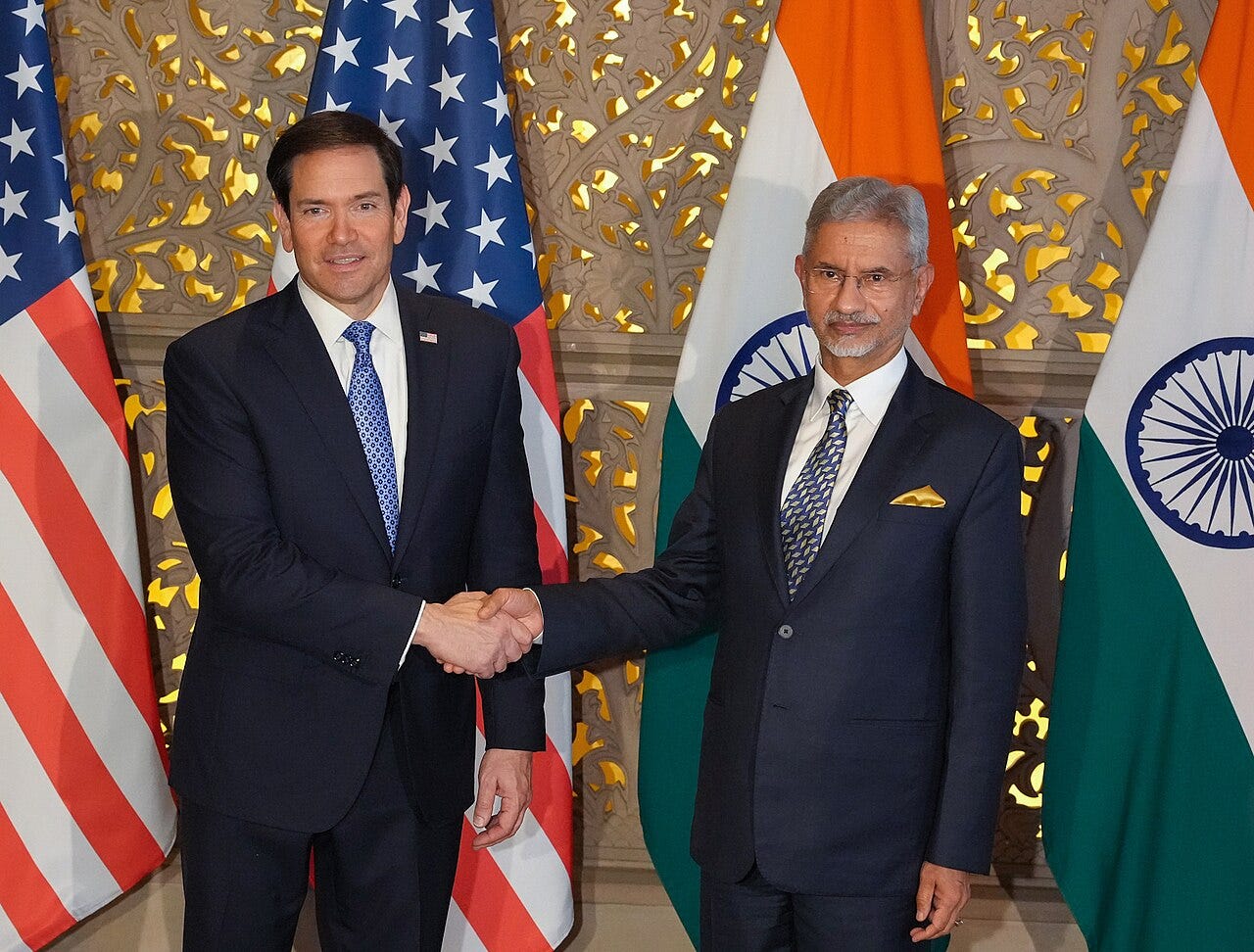
During the recent visit of US Secretary of State Marco Rubio to India, External Affairs Minister Jaishankar travelled to Mumbai to meet him. Some political statements portrayed the travel as the Minister having been ‘summoned.’ That interpretation seems emotion–driven. A few days earlier (October 9, 2026), the Ministry of External Affairs (MEA) issued an unusually firm response to US Vice President JD Vance’s “indentured servants” remark, made while announcing the suspension of the Permanent Labour Certification program. MEA called the formulation deeply offensive and unwarranted and said that it carried painful historical and colonial connotations. It was a public expression of anguish over the insensitive remarks. In India, `how’ something is said is as important as `what’ is said!
During the nearly two years of Trump’s second Presidency, insensitive remarks and disregard for other countries’ legitimate concerns have become the ‘new normal’ of US behaviour. In July 2025, late Senator Lindsey O. Graham warned India, China and Brazil over their purchase of Russian oil, saying, “...If you keep buying cheap Russian oil to allow this war to continue, we’re going to tear the hell out of you and we’re going to crush your economy, because what you’re doing is blood money.” Graham later co-sponsored the ‘Sanctioning Russia and Iran Act of 2026.’ These remarks, like many others, have contributed to souring Indian public opinion of the US. Likewise, Vice President Vance’s later admission that “his rhetoric was imperfect” did little to assuage Indian concerns. Even Rubio’s recent remarks that the US “relationship with no country in the world, in any way, comes at the expense of our relationship with India” are received with scepticism.
Concerns about the growing US – Pakistan ties, shift in Sino – US relationship, persistent high tariffs, and anti-India rhetoric in the US have eroded the sentiment of trust. That similar words and actions are being directed at other US allies and partners offers little consolation to Indians who feel slighted. Three years back (2023), when Seema Sirohi published “Friends with Benefits: The India – US Story,” the title of the book felt a bit “too blunt.” Looking back, I now think she highlighted the transactional nature of the relationship at least two years ahead of time.
The 2005 India-US civil nuclear deal is often considered a turning point in bilateral relations. It has often been presented by the US as an act of strategic altruism. It was, however, driven substantially by US interest in seeing India emerge as a democratic regional counterweight to China. Even in the current geostrategic context, the US considers India a `critical anchor to hold the line in South Asia’ (Hegseth – Shangri-La Dialogue – May 2026). It also remains essential for maintaining a favourable balance of power in Asia, particularly in the Indian Ocean geography.
The US also looks at India for skilled technical talent to revolutionise advancements in critical and emerging technologies. It finds India useful for resilient supply chains and to access its large-scale markets. Elon Musk’s recent criticism of delays in Starlink’s entry into India, and the quick toning down of the language, appear, to me, to be driven by the lure of accessing such a large market.
India, on its part, sees the US partnership as a way to build its own capacities and capabilities through strategic and economic cooperation. US capital, technology, defence and security ties, and industrial cooperation are considered essential for achieving India’s goal of becoming a developed nation by 2047 (Viksit Bharat).
There is no denying that this is an unequal partnership in economic, technological and military terms. The US has an estimated nominal GDP of $ 32.64 trillion and GDP per capita of $ 95,212. This ranks well above India’s estimated GDP of $ 4.06 trillion and GDP per capita of $ 2,750. (IMF World Economic Outlook, October 2026). In 2025, the US ranked first among India’s merchandise export destinations, accounting for 20.75% of exports. India recorded a merchandise trade surplus of $ 42.01 billion with the US (Department of Commerce, India). The US is also a major market for Indian services. Even for India’s defence exports, which have risen substantially to Rs 38,424 Crore in FY 2025-26, the US is a major export destination. It is also an important source of portfolio investments, Foreign Direct Investment, and a preferred destination for Indian students.
India currently hosts nearly 2117 Global Capability Centres (GCCs), employing about 2.36 million professionals. Over 60% of these are operated by US-based firms. These Centres have grown into strategic hubs for innovation and value creation, connecting Indian talent to the core operations of major global companies. Tangible industry-to-industry cooperation has also developed under the Biden-era Initiative on Critical and Emerging Technology (iCET), and its Trump 2.0 era successor, the US – India TRUST initiative (Transforming the Relationship Utilising Strategic Technology). Industries like Micron Technology, Applied Materials, AMD, and Lam Research have announced or already invested in the field of semiconductors. Likewise, Google, Microsoft, Amazon and Jabil have also made/committed to investments related to AI infrastructure and skill development. While private companies make investments, government initiatives like iCET and TRUST provide an enabling framework. This adds ballast to the relationship against future political turbulence.
Looking ahead from an Indian perspective, in the near term, creating jobs, attracting investments, expanding licensed production, and plugging into global supply chains are all important. In the mid to long term, however, the emphasis should be on moving up the value chain to develop own technological and manufacturing base. This is not to become a challenger, but an advanced and stronger partner of the US. A relationship based on complementary strengths is more resilient than the one based on dependence.
In the final analysis, India expects from the US, under President Trump (and beyond), a genuine recognition of its ‘stated’ strategic relevance. Inherent in that is mutual respect, sensitivity to India’s national interests, strategic autonomy and fair trade. India, in turn, should assure the US of continued strategic convergence, fair access to its markets, technological talent and industrial cooperation. Recognition of mutual expectations shorn of excessive sentimentalism should form the basis of India-US relations in the second half of Trump 2.0.
About the Author: Lieutenant General Anil Ahuja, PVSM, UYSM, AVSM, SM, VSM & Bar, superannuated in August 2016 as Deputy Chief of Integrated Defence Staff (Policy Planning and Force Development). During his distinguished military career, he commanded a Corps and a Division along India’s Northern Borders with China and served as Additional Director General of Military Operations. He also served as Secretary of the Defence Acquisition Council (DAC) and Co-Chair of the India–US Defence Technology and Trade Initiative (DTTI) Inter-Agency Task Force (DIATF).
Editor’s Note: This article by Lieutenant General Anil Ahuja (Retd.) is reproduced with the author’s permission. The original authorship and attribution remain with the author. Click here to access the author’s publication.