


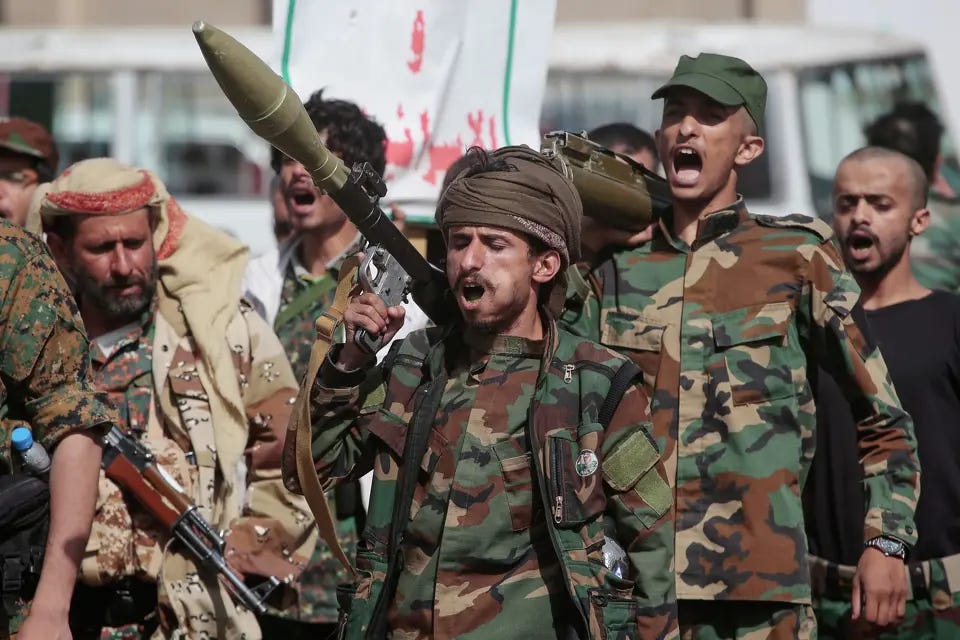
Yemen’s Houthi rebels march during a mobilisation campaign in Sanaa, Yemen, Thursday, Sept. 10, 2026.
Yemen’s Iran-backed Houthi rebels have reportedly captured the strategic Perim Island that sits in the Bab el-Mandeb Strait as they aim to tighten their grip on the critical maritime chokepoint. The Bab al-Mandeb Strait links Asia to Europe via the Red Sea and Suez Canal. The strait carries 12% of global trade, with millions of oil barrels. Perim Island, also known as Mayun, divides the waterway in two, close to its narrowest point. Between September 9 and September 11, the Houthis captured several important towns, including Hays, Al-Khawkhah, the key port city of Mocha, and Dhubab. Houthi military spokesman Yahya Saree said they captured about 5,400 square kilometres, or around 90 per cent of Yemen’s western Red Sea coastline. As Houthi forces launched a major offensive against government positions across Taiz and Hodeidah, the government-backed Joint Forces reported holding their lines and launching counterattacks.
Saudi Arabia had to shut down a major pipeline a day after drones attacked it. Saudi Arabia said that the drones came from Iraq, which is home to Iranian-backed militias. Yemen’s Iranian-backed Houthi rebels simultaneously captured the strategic island at the southern entrance to the Red Sea, opening a new chapter in the regional conflict. Saudi Arabia, calling it a precautionary measure, temporarily shut down its Petroline, the 1,201-kilometre East-West pipeline running from Abqaiq to the Red Sea port of Yanbu. As Riyadh was relying on this pipeline to bypass the blockaded maritime straits, its closure compounds an ongoing export crisis that had already driven Saudi crude oil shipments to a 13-year low.
Axios reported, citing two US officials, that Saudi Crown Prince Mohammed bin Salman called US President Donald Trump twice to urge him to launch strikes against Iran-backed Houthi forces in Yemen as the group advanced towards the strategically important Bab el-Mandeb Strait. The Houthi advance is not only an embarrassment for Saudi Arabia. It also gives Iran new leverage in its war with America: its allies have bolstered their grip on another vital waterway.
The Saudi–Houthi conflict is not simply a Sunni–Shia religious war. The Saudi–Houthi conflict grew out of Yemen’s internal political crisis and continued as a part of the wider Saudi–Iran rivalry. The Houthis, a Zaydi Shia movement from northern Yemen, seized Sana’a in 2014. They expanded southward, weakening the government of President Abdrabbuh Mansur Hadi, which led him to flee the country. Saudi Arabia viewed their rise as a threat to its border security and feared growing Iranian influence in Yemen, as Iranians provided armed and economic assistance to Houthis. After Hadi requested military assistance, Saudi Arabia formed an Arab coalition and launched Operation Decisive Storm on 26 March 2015. The campaign relied mainly on-air strikes, naval pressure and support for anti-Houthi forces. The operation failed to remove the Houthis from Sana’a or restore the Hadi government’s control over Yemen but degraded Houthi military capabilities, particularly heavy weapons and ballistic-missile assets, and secured control of Yemeni airspace and surrounding waters. The Saudi intervention increased Houthi hostility towards Saudi Arabia and made Riyadh one of their main enemies
This year’s clash between Saudi and Houthi forces can also be related to an event on July 13, when Saudi-backed Yemeni government forces carried out an airstrike on Sana’a Airport’s runway to stop an unauthorised Iranian aircraft from landing, forcing it to divert. This followed a July 3 incident where an Iranian flight transported Houthis to Khamenei’s funeral, violating government sovereignty. In retaliation for the runway attack, the Houthis launched strikes against Saudi Arabia’s Abha Airport. This clash marks the most severe escalation between Saudi Arabia and the Houthis since the 2022 truce, with Houthis vowing to end their airspace blockade. A return to serious fighting looked inevitable, and it was obvious that the Houthis would try to seize the coast.
What is interesting to see is Pakistan’s silence on the attacks by the Houthis. Pakistan, which shows itself as a regional ally of Saudi Arabia and relies on Saudi assistance and remittances, is also a signatory to the much-talked-about Mecca Pact, signed by Saudi Arabia and Turkiye. But within 48 hours, Islamabad has reportedly responded, “There is no such thing under discussion right now…When the time comes, we will act under the agreement.”
Now it’s time for Saudi Arabia to take more stringent military measures. Diplomacy cannot be used as an instrument to control an ideology-driven militia group. In April this year, Saudi Arabia’s critical pipeline to the Red Sea was attacked by Iran, cutting 700,000 barrels per day and now by the Houthis. The Houthi advance towards Bab el-Mandeb significantly alters Saudi Arabia’s strategic position in the Red Sea. For now, Saudi Arabia’s main pressure is protecting maritime trade and preventing an Iran-aligned armed group from gaining leverage over one of the world’s most important chokepoints.