


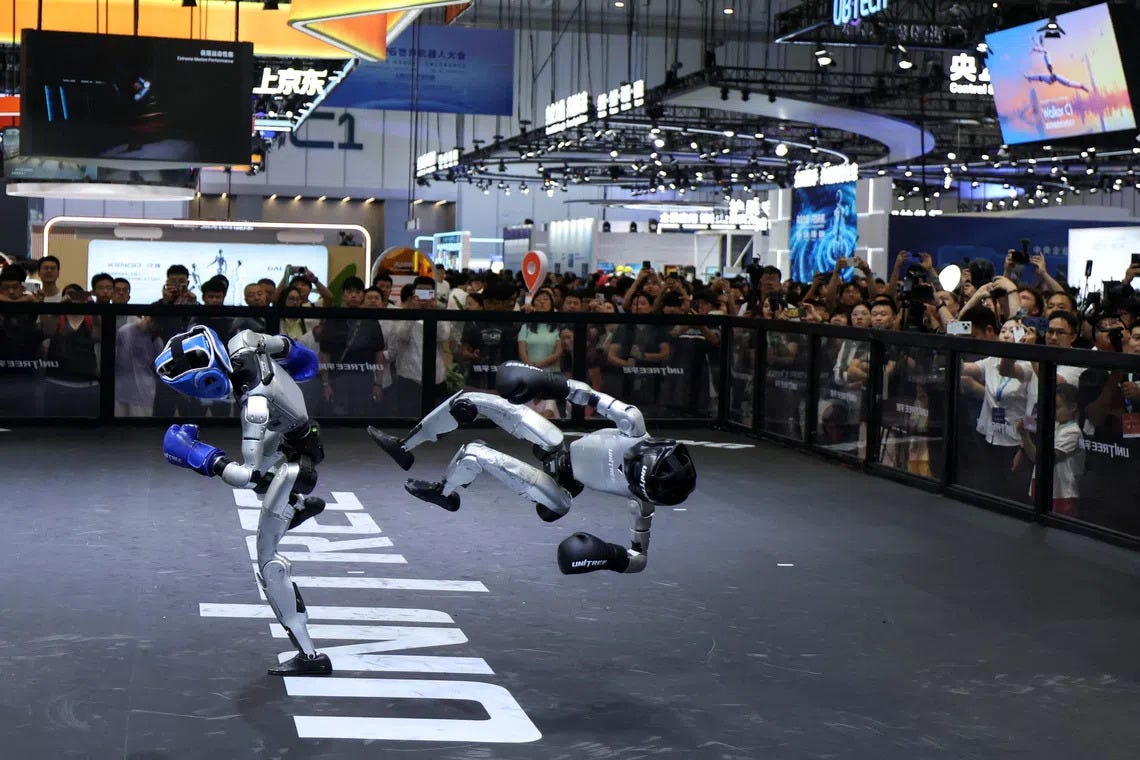
World Robot Conference in Beijing on Aug 19. Photo: REUTERS
Investors are placing enormous bets on what robots could eventually become over time, since two agile humanoid robots traded roundhouse kicks and punches, a less nimble robot spent nearly two minutes trying to fold a T-shirt and a humanoid robot, Tiangong Ultra, achieved a remarkable feat at the World Humanoid Robot Games in Beijing by clocking 9.39 seconds in the 100m sprint, surpassing Usain Bolt’s world record of 9.58 seconds.
Tiangong Ultra, developed by the Beijing Humanoid Robot Innovation Centre, won the race by overtaking smartphone maker Honor's robot, Lightning, near the finish. Both robots crashed into a thick mat positioned to stop them, with Tiangong veering wildly off course into the sidelines and forcing spectators to clear out of the way, while Lightning collapsed to the ground and had to be carried off on a stretcher.
The world’s largest producer of humanoid robots, none other than China, is increasingly putting both its industrial might and capital markets behind the development of humanoid robots. Unitree raised 6.1 billion yuan (S$1.15 billion) in an initial public offering that was more than 8,000 times oversubscribed, making it the first humanoid robot maker to list in mainland China.
A report from Morgan Stanley projects that China's robotics market will more than double from $47 billion in 2024 to $108 billion by 2028, expanding at an annual rate of 23 per cent. China already accounts for about 40 per cent of the global robotics market, underscoring its rising stature as an innovation hub. China has also built a supply chain spanning core chips and key components through to finished products, giving it the foundation to handle everything from design to production on its own.
From a systems engineering perspective, the biggest challenge is moving from a research prototype to a reliable operational system. Many humanoid robots today are somewhere in the middle of that scale. Demonstrations show that the core technology works, but significant effort is still required to make the systems reliable, safe and maintainable in real environments. A general-purpose robot may be flexible, but it may not perform specific tasks as efficiently as a robot designed for that particular task. In many cases, application-specific robots may still be the more practical solution.
China’s lead has been years in the making. The humanoid robot industry was listed as one of the key industrial areas for technological breakthroughs in its 14th Five-Year Plan in 2021. State funding is being used for both testing infrastructure and backing individual companies.
But despite China’s current dominance, the West will not necessarily become reliant on buying Chinese robots, as Tesla has been developing a general-purpose robot called Optimus for over five years. Tesla’s Optimus robots can now perform “simple tasks” inside the company’s factories and can be made accessible to the general public by the end of 2027.