


An image of a torii gate at sunset, a steaming bowl of ramen, or a tatami room glowing in soft light can instantly evoke a traditional experience of Japanese culture. From ikebana to kabuki theatre and ukiyo-e woodblock prints, Japan’s traditional arts have become a global trademark for beauty and minimalism. Areas like anime, manga, cuisine, design, and technology helped Japan to develop an identity and establish its soft power across the world.
The Cool Japan strategy is integral to Japan’s post-war cultural diplomacy. The formation of the Cool Japan initiative was shaped by the global success of a Japanese television drama named Oshin, which aired in the early 1980s. The show became popular in 68 countries. This made Japan realise the potential of cultural exports as a means of nation branding and revenue generation. The official launch of the Cool Japan Project came in 2013, with the launch of the Cool Japan Fund, saw an initial investment of ¥50 billion over a span of 20 years. The fund has one clear direction: to promote and finance projects that promote Japanese culture abroad, increasing tourism, boosting foreign investment, and expanding the market reach for Japanese products.
The Ministry of Economy, Trade and Industry planned to dissolve the public-private Cool Japan Fund, formally the Fund Corporation for the Overseas Promotion of Japan’s Culture. The government-led investments failed to generate the expected returns, and Cool Japan’s losses began to pile up. The fund invested not only in content such as animation and games but also in restaurants, department stores and fashion, yet many of those ventures fell short of expected profits. The government of Prime Minister Shinzo Abe launched the initiative in 2010 and set up the Cool Japan Fund to handle related investments in 2013. Japanese officials had said the policy was influenced by the “Cool Britannia” campaign under British Prime Minister Tony Blair’s government, though it was also seen as a response to the global rise of the Korean Wave.
Prime Minister Sanae Takaichi’s government has continued its support for the content industry even after the Cool Japan Initiative fund was discontinued. It was listed along as one of the core industries, along with AI and semiconductors. Prime Minister Sanae Takaichi has unveiled a plan to set up a new investment quota for 17 growth areas, ensuring sufficient budget allocations by exempting the 17 sectors from the rule limiting financing for related project funds to three years in principle. Takaichi’s first economic blueprint, compiled in July, says the government will seek to work with the private sector to channel resources into strategic industries, with combined public and private investment projected to exceed 370 trillion yen ($2.4 trillion) through fiscal 2040. This economic transformation also has an important foreign-policy dimension by building a regional environment favourable to its long-term national interests
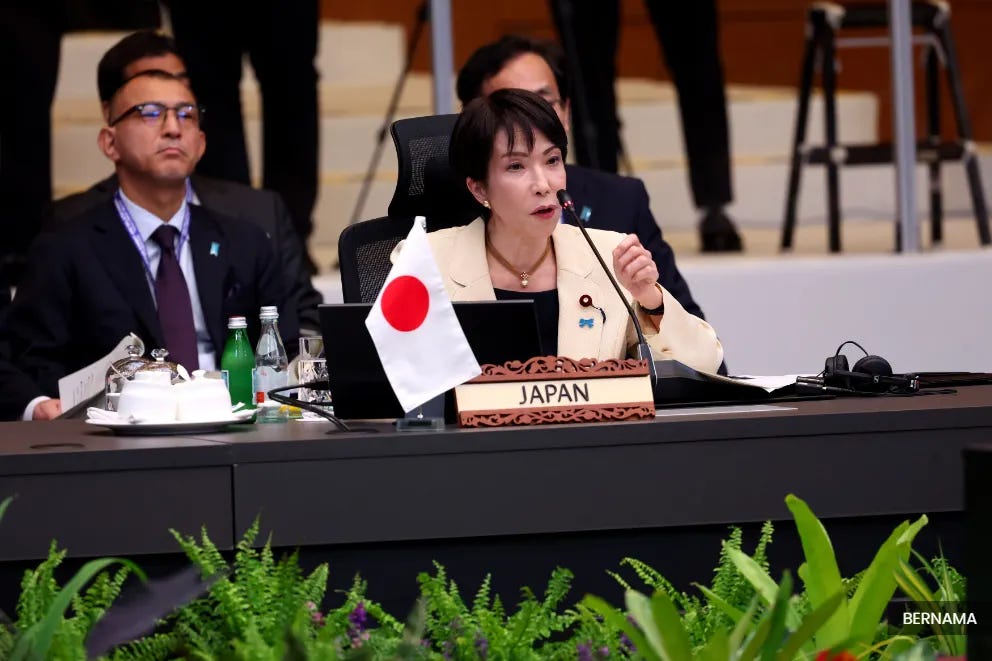
Taking a look at Tokyo’s foreign policy agenda, Ms Takaichi Sanae in Hanoi, Vietnam, delivered a speech, announcing Japan’s updated “Free and Open Indo-Pacific (FOIP)”. It prioritises three areas of initiative for FOIP that is Building economic infrastructure for the age of AI and data, including strengthening supply chain resilience for energy and critical materials; co-creation of economic growth opportunities through public-private collaboration and rule-sharing; and enhancing cooperation in the field of security to ensure regional peace and stability. She expressed her conviction that, through these efforts, Japan and the entire Indo-Pacific region, including ASEAN, can become “stronger and more prosperous together.”
Takaici cited the following initiatives in the ASEAN region: (1) strengthening supply chain resilience through the “POWERR Asia”; (2) AI cooperation under the “Japan-ASEAN Co-Creation Initiative for AI”; (3) the FOIP Digital Corridor Concept including undersea cables, Open RAN, satellite communications, and all-optical networks, among others; (4) the expansion of the CPTPP; and (5) cooperation in the security field, including in the maritime domain, through OSA, ODA, and other frameworks. Above all, Japan’s recent defence buildup has been driven by the imperative of concentrating on the security challenges in Asia posed by China and North Korea. Japan’s long-term security establishment has been oriented towards deterrence and defence in the Indo-Pacific. Japan has refrained toward participation in military operations in the Middle East or any other distant areas.
Culture remains an important asset, but it is treated alongside semiconductors, artificial intelligence, resilient supply chains and defence capabilities as an instrument of national power. Takaichi has been seen focusing on regional security issues as well as updating strategic culture to boost growth and revenue generation. As her term is completing next year, it is essential to observe how Japan shapes its national interest and strategically plans its regional goals.