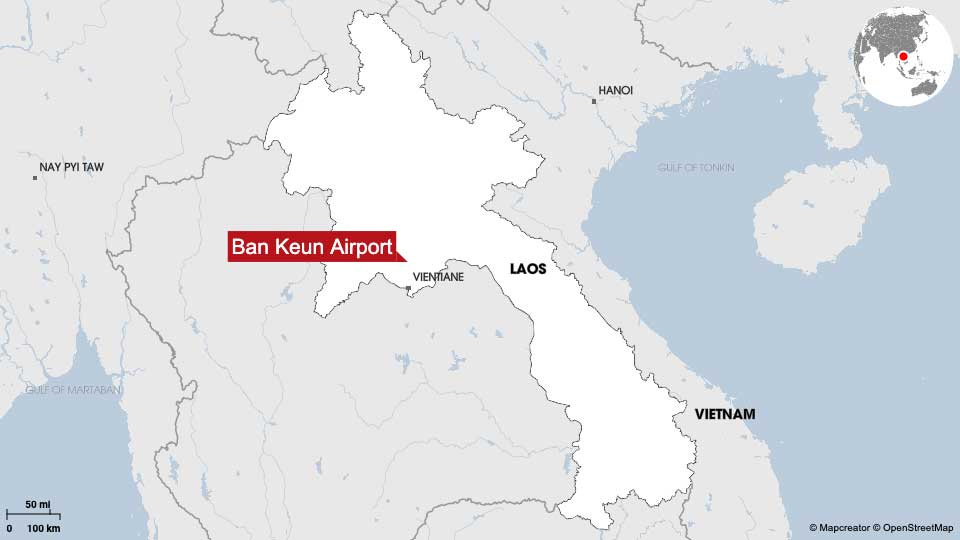
Light attack aircraft and military vehicles have arrived at the new China-Laos joint training facility. Roughly 50 km north of Vientiane (the capital and largest city of Laos, located along the Mekong River near the Thai border), China and Laos have opened the China–Laos Joint Support and Training Centre and the China–Laos Friendship Aviation Academy at Ban Keun Airport, Reuters reported. China’s Defence Ministry announced that the new facilities began operations on 29 September 2026.
This new venture would be used to train Laos Air Force pilots and enhance military cooperation. The Chinese official statement added that the training centre “is not directed against any third party”.
Junwu Ciweimian (军武次位面), a popular Chinese military commentary account, pointed to two main reasons for choosing Ban Keun. First is transportation. Ban Keun lies along the China-Laos Railway corridor, making it easier to move personnel and equipment from China. Second is geography. Ban Keun is close to the capital, making it convenient for trainees and easier for the Lao government to manage. The surrounding area is also relatively flat compared with much of mountainous Laos, making it better suited for an airfield and flight training.
Ban Keun is China’s third significant overseas military outpost, after the joint support and training centre at Cambodia’s Ream Naval Base on the Gulf of Thailand and China’s logistics base in Djibouti.
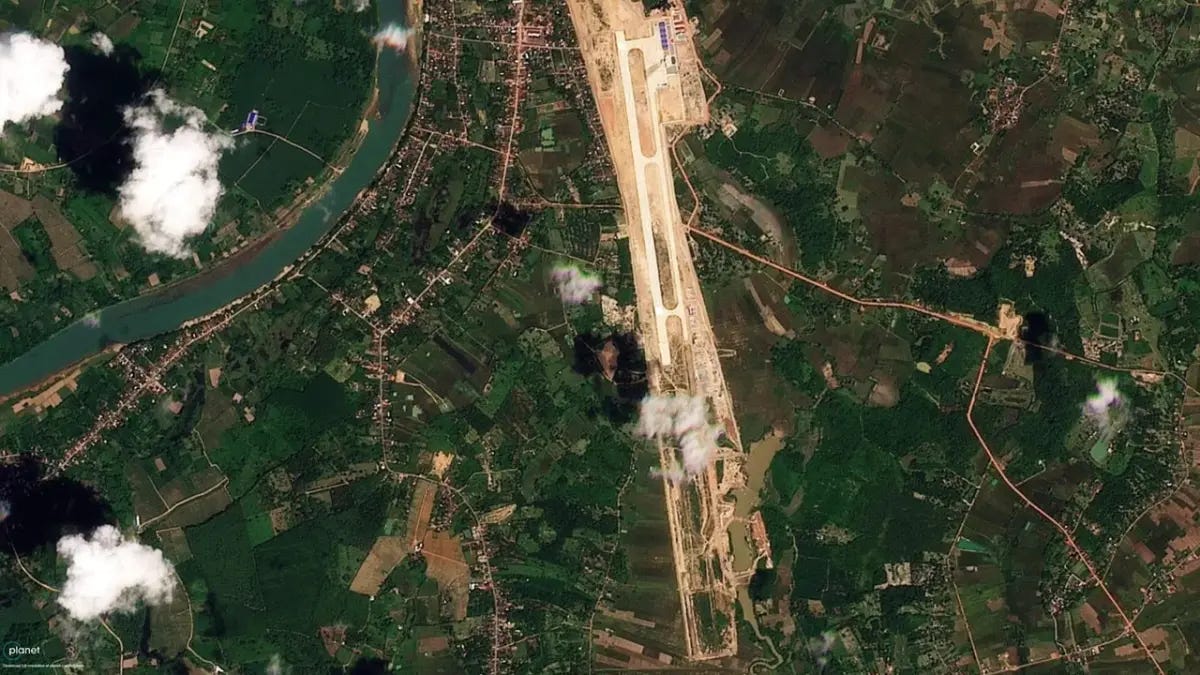
According to Reuters’ analysis of commercial satellite imagery, construction began in late 2025. Satellite images now show a runway about 2,000 meters long, an accompanying taxiway, tens of thousands of square meters of apron space and an air traffic control tower, with most supporting infrastructure already in place.
This is long sufficient to land most People’s Liberation Army (PLA) fighter jets, including the J-10 and J-11, as well as Y-20B transport aircraft, but too short to support long-range PLA bombers, which require closer to 3,000 metres, as indicated by a Lowy Institute member, David Vallance.
This military initiative plans to strengthen the Lao Air Force, which currently operates with a small fleet comprising three Yak-130 advanced trainers and four Chinese-made K-8 trainers. Additionally, Ban Keun Airport could support Chinese air force operations across mainland Southeast Asia, as several major cities are situated within a 500–700 kilometres range; this would potentially strengthen China’s capacity to project power and expand its influence across the Indochina Peninsula.
According to a report in The Diplomat, the greater significance lies in its potential role as a transit base for the PLA Air Force. From this location, Chinese forces would have a certain level of operational reach toward Myanmar and farther south toward Singapore. For the United States, Singapore and Thailand are both important logistical and replenishment locations, particularly during periods when US aircraft carriers are rotating or undergoing maintenance. These locations would potentially fall within the operational range of aircraft operating from Ban Keun.
US forces are believed to have used the Ban Keun airport in Laos, then known as “Lima Site 44”, during covert military operations at the height of the Vietnam War in the 1960s and 1970s. In the future, the facility could also be used to complicate US military operations in the Gulf of Thailand, the Andaman Sea, and even the Strait of Malacca.
Vietnam is highly concerned with the development as it has long seen Indochina as its backyard. Rear Admiral Surasant Kongsiri, spokesperson for Thailand’s Defence Ministry, told Reuters that Thailand is a close partner of both Laos and China, and that Laos has the sovereign right to decide whether to host a Chinese facility. “Nevertheless, Thailand will continue to closely monitor developments and how the matter proceeds, particularly concerning building mutual trust.”