


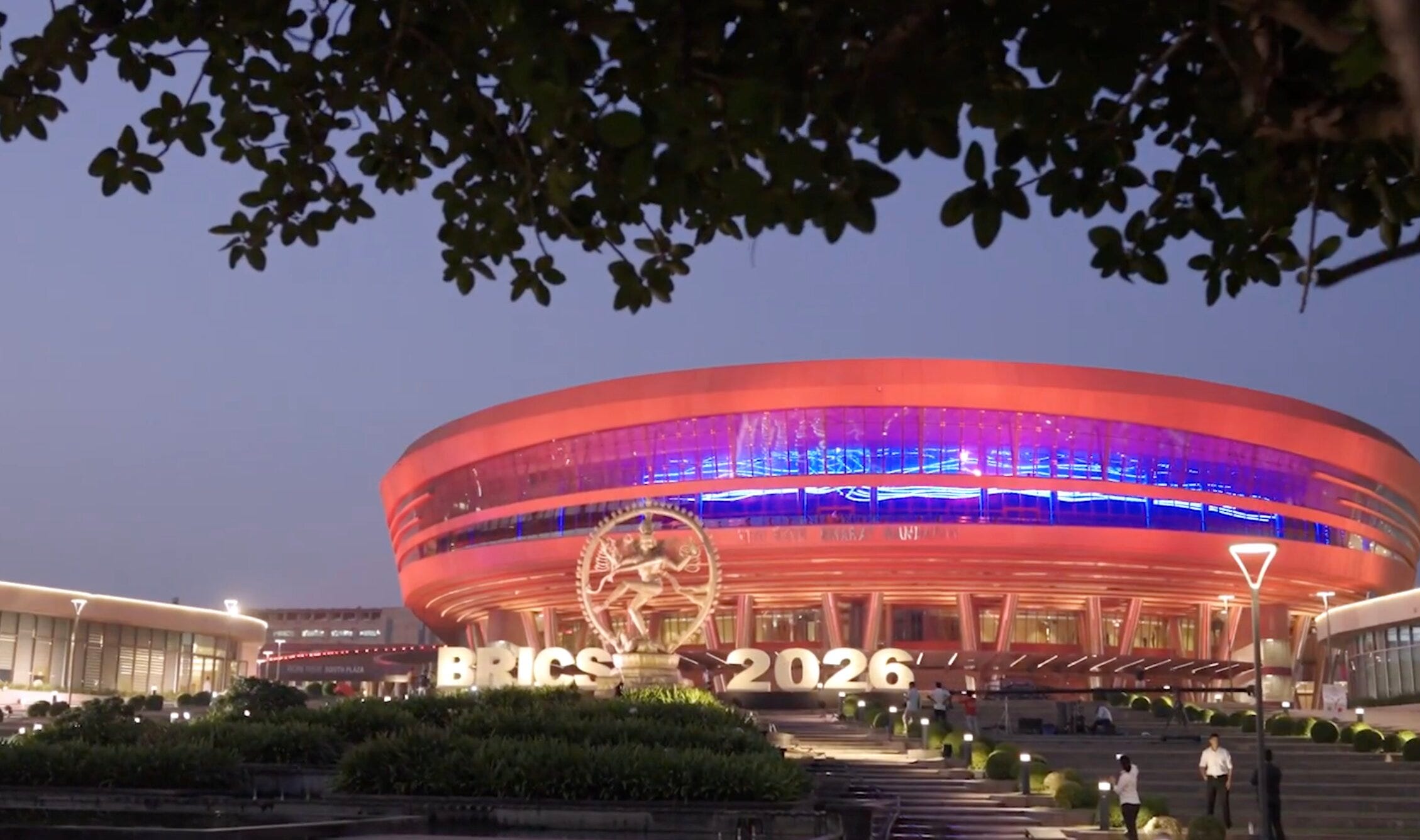
Over the past two decades, BRICS has grown into a major platform for cooperation among emerging markets and developing countries, with an ever-expanding role in global affairs. As the chair this year, India will be hosting the 18th BRICS Summit on September 12-13 at Bharat Mandapam in New Delhi. The summit will bring together leaders of BRICS member and partner countries as well as outreach invitees, according to the Ministry of External Affairs.
The theme for India’s BRICS chairship is ‘Building for Resilience, Innovation, Cooperation and Sustainability’. India, a founding member of BRICS, has previously held its chairship in 2012, 2016 and 2021. India assumed its fourth BRICS chairship on January 1, 2026. BRICS is celebrating its 20th anniversary this year.
Russian President Vladimir Putin arrived in New Delhi on Friday for a three-day visit to India. He is scheduled to participate in the BRICS Summit and meet Prime Minister Narendra Modi to discuss ways to expand bilateral trade, investment and energy cooperation. Kremlin spokesperson Dmitry Peskov in an online interaction with India-based journalists organised by Russian media outlet Sputnik India, described BRICS as a flexible club organised around policy and security, economics and finance, and cultural and humanitarian cooperation. On multipolarity in BRICS, he said the ideology and the nature of BRICS correspond with the ideology of a “multipolar world” because cooperation in BRICS is based on “mutual trust, mutual respect, mutual benefits in trade”.
Chinese President Xi Jinping will attend the 18th BRICS Summit in New Delhi from Sept. 12 to 13, a Chinese foreign ministry spokesperson announced on Thursday. China, as an active supporter and participant in BRICS, has consistently upheld the BRICS Spirit of openness, inclusiveness and win-win cooperation, working with its partners to turn shared aspirations into practical cooperation and advance common development. According to 2026), at the upcoming summit, Xi will join other leaders in charting a new course for the high-quality development of greater BRICS cooperation, pooling the collective strength of the Global South and contributing stability and positive momentum to a world undergoing profound changes.
United Nations Secretary-General Antonio Guterres also landed in New Delhi. Along with these key dignitaries, a lot of other leaders will also join the event. Other stand-ins reportedly under consideration include Uganda's Vice President Jessica Alupo, Vietnam's Prime Minister Le Minh Hung, and Abu Dhabi Crown Prince Sheikh Khaled bin Mohamed bin Zayed Al Nahyan, who would attend in place of his father, UAE President Sheikh Mohamed bin Zayed Al Nahyan. Brazil, one of the bloc's founding members, is unlikely to see President Luiz Inácio Lula da Silva attend in person due to the country’s election campaign.
The situation around Iran is the most pressing political issue facing BRICS, Russian Deputy Foreign Minister Sergey Ryabkov said in an interview with TASS. “With regard to Iran, the situation is complicated by the fact that there are countries within BRICS that take a sharply critical stance toward what Tehran is doing and has been doing recently,” Ryabkov said. “The Gulf conflict is going to be the central fault line this time during the BRICS summit,” said Harsh V Pant of India’s Observer Research Foundation. “What was seen until last year as an achievement – the expansion of BRICS – today looks like a big constraint on BRICS”. It will be Pezeshkian’s first visit to India as Iranian president and will put the Middle East conflict firmly on the agenda.
Finance ministers and central bank governors of BRICS countries have called for reform of global developmental financial institutions such as the International Monetary Fund and World Bank, seeking a stronger voice for emerging market economies. While acknowledging the work done by the BRICS payment task force, the finance chiefs pushed for progress in ensuring greater interoperability of payment systems across member nations. The BRICS Payment Task Force continues discussions, building on the ongoing work, to facilitate practical solutions for cross-border payments among BRICS countries, with fast, low-cost, more accessible, efficient, transparent, and safe modes. BRICS members will focus on making international financial institutions more representative, transparent and accountable.
The Economic Times reported earlier that India, which currently holds the BRICS presidency, is likely to present a concept for seamless cross-border digital payments and the introduction of central bank digital currencies among the group’s member states at the summit of the bloc. Reuters reported in January that the Reserve Bank of India had proposed linking the official digital currencies of BRICS countries to facilitate cross-border trade and tourism payments. The proposal could reduce reliance on the dollar, although the RBI has maintained that efforts to internationalise the rupee are not aimed at promoting de-dollarisation.
On September 7, 2026, H.E. Mr. Xu Feihong, Chinese Ambassador to India, published an article entitled “Harnessing BRICS ‘POWER’ to empower the world” in The Hindu, giving an acronym of POWER where P for Principle, O for Openness, W for Win-Win, E for Engine, R for Responsibility. The article focuses on how the world economy is currently facing a sluggish recovery, coupled with the spread of protectionism. Certain countries have undermined the international economic and trade order by erecting tariff barriers, seeking decoupling and disrupting supply chains. It should be recognised that economic globalisation is an inevitable trend of history. BRICS should uphold the multilateral trading system with the World Trade Organisation (WTO) at its core, safeguard the basic principles of the WTO such as the most-favoured-nation treatment, and resist all forms of protectionism. We should join hands to deepen cooperation in energy and mineral resources, infrastructure, and industrial and supply chains to maintain an open global economic landscape. It also focuses on accelerating the implementation of the UN Sustainable Development Goals, strengthening dialogue and building consensus on launching the formulation of the post-2030 global development agenda. Mr Xu Feihong also focuses on promoting the integration of artificial intelligence (AI) with sectors including science and technology, health, agriculture and education, thereby injecting fresh impetus into world economic growth. China has established the China-BRICS AI Development and Cooperation Centre and the China-BRICS New Quality Productive Forces Research Centre and welcomes the active participation of all parties.
The UAE joined the New Development Bank in October 2021 and formally became a member of BRICS in January 2024, as part of its broader approach to expanding international economic partnerships and strengthening its presence across multilateral economic and financial cooperation platforms. Non-oil foreign trade between the UAE and BRICS economies exceeded $312 billion in 2025, rising 28.5 per cent from $243 billion in the previous year, according to figures highlighted by UAE Minister of Foreign Trade Dr. Thani bin Ahmed Al Zeyoudi during the BRICS Trade Ministers Meeting in Jaipur in August. BRICS markets accounted for approximately 31 per cent of the UAE’s total non-oil foreign trade in 2025.
Institutions create history. BRICS has completed twenty years expanding its membership, enlarging its economic weight and becoming an increasingly consequential voice of the Global South. Yet power alone does not make a grouping consequential. The harder task is to turn numbers into effectiveness, diversity into cooperation and declarations into outcomes. India has sought to move the grouping from dialogue towards delivery, with five joint declarations, three new centres or platforms and a landmark MOU on standardisation. BRICS has acquired the scale to reflect a changing world, with upcoming responsibility as a leader in the Global South, when the world is facing several conflicts in multiple regions.