


“Shah raft, gheseh baghi mand”. The Islamic Republic of Iran has entered its most consequential political experiment since 1979. For nearly 37 years, from June 1989 until February 2026, Ali Khamenei showcased clerical dictatorship. He transformed the office of Supreme Leader into the centre of extensive political repression, economic domination, and institutionalised impunity.
Today, that central pillar is gone. Following the death of Ayatollah Ali Khamenei in joint US-Israeli airstrikes on February 28, 2026, Iran is adapting to an unprecedented political reality of functioning without an active, visible supreme leader.
Mojtaba Khamenei, the 56-year-old son of Ayatollah Ali Khamenei, has been absent, leaving day-to-day authority with a compact group of military, security and civilian officials. He formally rules Iran but communicates only via written statements, with no public appearances even missed his father’s funeral in Mashhad.
Mojtaba Khamenei has never run for office but is a highly influential figure in the inner circle of the supreme leader, establishing deep ties to the Islamic Revolutionary Guard Corps (IRGC). His silence is a result of fear of assassination, but Iran’s theocratic clerical foundation has attenuated: A pop star once prosecuted for religiously themed songs has returned, restaurants serving French wine and public Halloween celebrations are increasingly challenging the ethos.
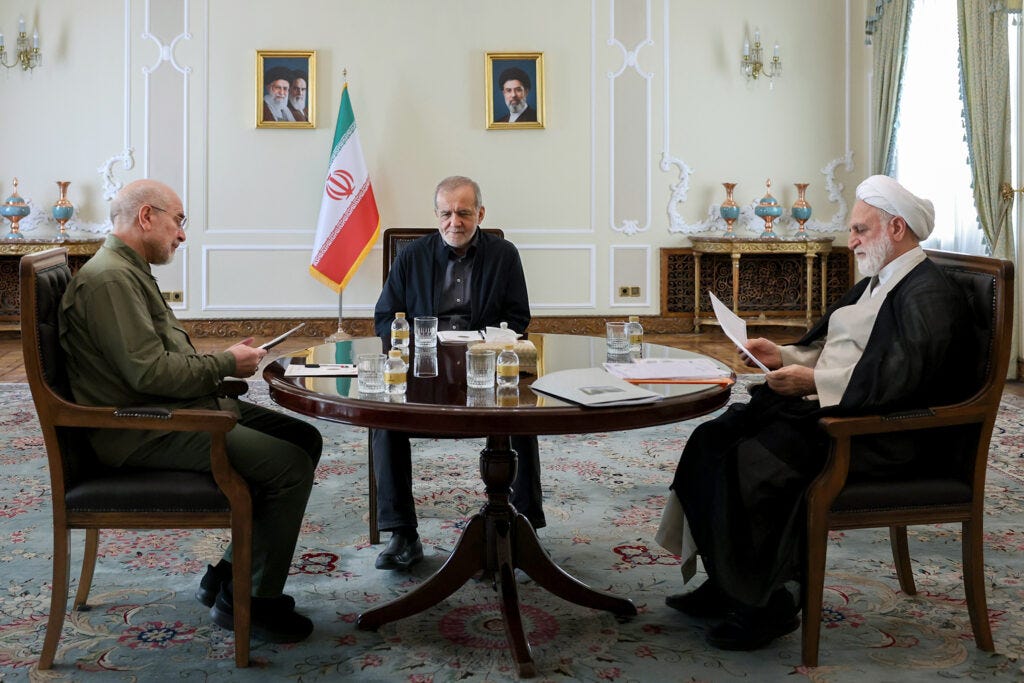
President Masoud Pezeshkian, in an interview with CBS News, said that a team consisting of government officials, security forces and parliamentary representatives are likely to shape decisions for the country in the present. According to a report by The Economist, the six-member decision-making group includes President Masoud Pezeshkian, IRGC Commander Ahmad Vahidi, Supreme National Security Council Secretary Mohsen Rezaei, Parliament Speaker Mohammad Bagher Ghalibaf, Chief of Staff of the Armed Forces Ali Abdollahi, and Foreign Minister Abbas Araghchi. The committee is said to handle major questions, including nuclear policy, negotiations and the war, with decisions taken through collective coordination in the absence of an active, publicly visible Supreme Leader Mojtaba Khamenei.
Iran is currently experiencing an economic crisis on the verge of severe financial instability. Analysts at the Institute for the Study of War (ISW) note that the US is now explicitly targeting sanctions‑evasion networks to deepen Iran’s isolation. The rial’s depreciation and the US Navy blockade’s impact on export revenue are putting immense economic pressure on households and even security forces reliant on state salaries. Kpler reports state that Iran’s oil exports declined from 1.85 million barrels per day to around 255,000 barrels, leading to a 10% contraction in the economy. Half a million people have remained unemployed since the war, and over half of all jobs are now in the informal sector.
Pezeshkian has sought to keep Iran’s economy connected despite the war. Overland trade has expanded, with regular freight services linking Caspian ports to Tehran. Gas supplies and regional trade routes remain partly operational. Meanwhile, tanker tolls and informal money transfers through the UAE continue to provide Tehran with much-needed foreign currency.
Hossein Taeb, a hardline cleric and former intelligence chief, has returned to lead the Basij, the IRGC’s domestic paramilitary force. He previously held the position from 2008 to 2022 and played a key role in suppressing anti-government protests in 2009. His close ties with Mojtaba Khamenei and experience in domestic intelligence make his appointment significant.
It signals the leadership’s concern about maintaining control at home while fighting a war abroad. By placing a trusted ally in charge of the Basij, Mojtaba Khamenei may be seeking to strengthen the regime’s ability to contain domestic opposition and prevent public discontent from becoming a wider challenge to its authority.
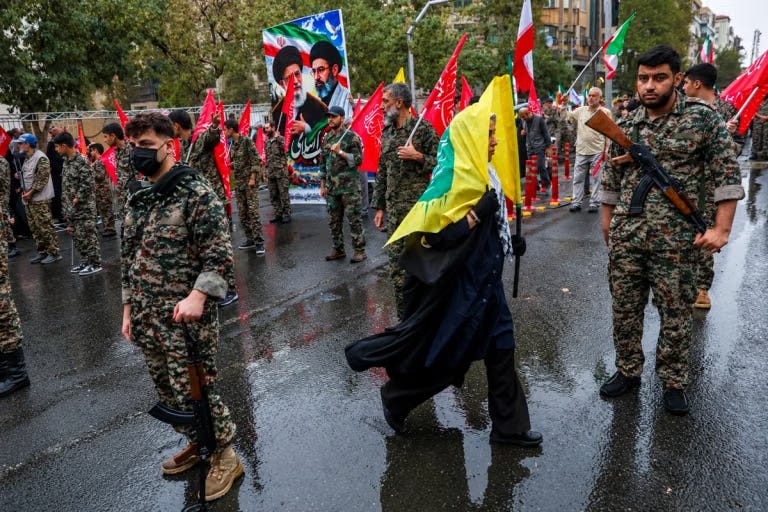
Iran’s Revolutionary Guards are using patriotism to widen recruitment for military training and the Basij, a paramilitary force known for suppressing dissent. The Janfada initiative, which promotes sacrifice for the homeland, presents participation as national service, potentially attracting citizens reluctant to join the regime’s security forces.
Strait of Hormuz acts as an integral strategic leverage for Iran. Beyond crude oil, the waterway carries one fifth of the liquefied natural gas, one-third of the fertiliser, half of the sulphur, and one-third of the helium. By establishing the Persian Gulf Strait Authority and launching selective transit tolls, Iran has asserted maritime sovereignty, demonstrating its ability to destabilise global commodity markets and raise the cost of conflict for Washington and its regional partners. Intermittent attacks on tankers allow Iran to destabilise shipping through the Strait of Hormuz
Iran wants a deal that relieves economic pressure without appearing to surrender; Washington wants a deal that constrains Iran’s nuclear and regional leverage. Crisis Group’s Ali Vaez argues that the current equilibrium is inherently unstable because each side believes time may eventually favour it. As reported in PBS News, "Tehran has repeatedly signalled that it will respond to growing U.S. pressure by moving up the escalation ladder, not by backing down," Danny Citrinowicz, a senior researcher at Israel's Institute for National Security Studies and a former Israeli intelligence officer focused on Iran, wrote on X.
Deputy Foreign Minister Kazem Gharibabadi, in an interview with the IRNA news agency, stated that the Islamic Republic and all its institutions have prepared for three scenarios, he explained: first, readiness for the diplomatic track; second, readiness to counter the United States' harsh sanctions policies, including maritime, land, and aerial blockades; and third, readiness to confront any potential military action or resumption of war by Washington.
Iran’s nuclear file remains the central obstacle to a durable U.S.–Iran settlement. The IAEA says it is “increasingly concerned” because it cannot inspect Iran’s declared Isfahan enrichment plant or verify its stockpile of uranium enriched to 60%, close to weapons-grade purity.
Iran has refused inspection until the war ends and its conditions are met, while insisting that no enriched material will leave the country. The G7 and France, Germany, and the United Kingdom (E3) have urged Iran to halt enrichment and restore full IAEA verification, warning of further measures if it escalates, while Washington links any ceasefire to nuclear constraints, leaving modern diplomacy fragile. IAEA’s 35-member Board of Governors formally reported Iran to the UN Security Council because it found Iran had failed to meet its nuclear safeguards obligations mainly by not fully declaring nuclear material and activities and by restricting inspector access
Iran’s new leadership may be less charismatic than the old, but it may be harder to decapitate. A distributed command structure means that missiles, proxy networks and naval harassment can continue even if senior figures are killed. Confrontation with Washington has pushed Tehran closer to Russia and China. If the blockade continues to strangle exports, inflation accelerates and public order frays, the six-man council may disintegrate. The future diplomacy of Iran rests on how fast the committee works, how hard it bargains, and how efficiently it acts.